Nermin Ülker: ‘Sometimes the way to express something is to leave it incomplete’
Nermin Ülker’s exhibition “Dört Köşeli Üçgen: Yerini Bulamamış Cümlelerin Anıtları”, curated by Filiz Ağdemir, is on view at Black Light Gallery from 16 October to 5 December. We spoke with Nermin Ülker and Filiz Ağdemir about the show.
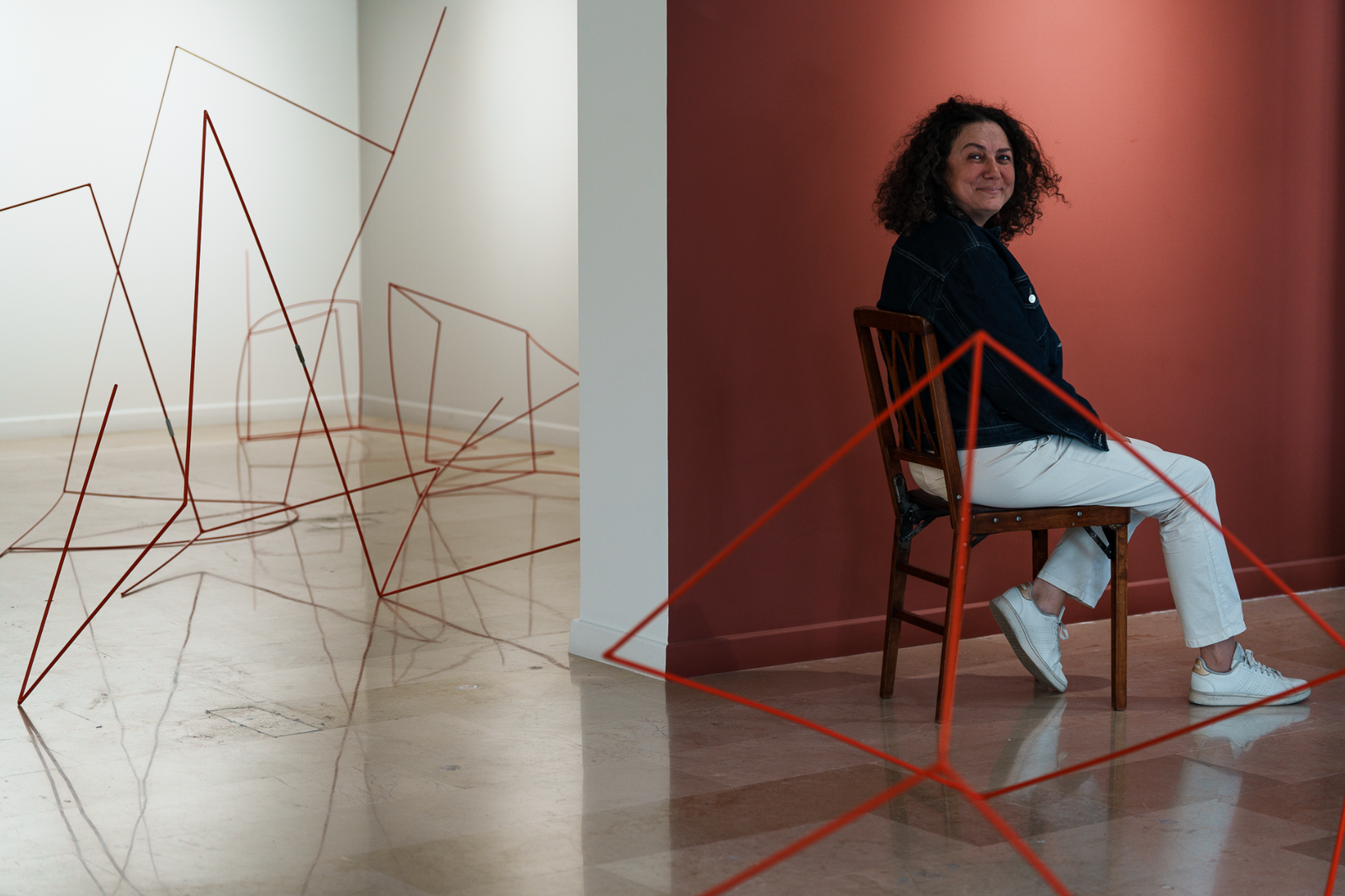
Nermin Ülker’s exhibition Dört Köşeli Üçgen: Yerini Bulamamış Cümlelerin Anıtları, which takes its name from Salâh Birsel’s only novel, published in 1961, centres on words that were never formed, never voiced and never found their place because of the price that “saying” them would exact.
The artist works mainly in metal, and the metal sculptures that were completed by voids in her previous exhibition become sentences in this one. By turning words she has carried for a long time into monumental sculptures, Ülker offers them another realm of existence.
We spoke with Nermin Ülker and Filiz Ağdemir about the exhibition, curated by Filiz Ağdemir, which is on view at Black Light Gallery from 16 October to 5 December.
Could you tell us how the exhibition came about and took shape?
Nermin Ülker: After the loss I suffered this summer, my relationship with life changed and I found myself in a long, heavy period of grief. In my practice, the books I read, the things I come across in everyday life and my memories set my thoughts in motion; then I start making models and preparing projects. Many of these projects are never realised or shared with anyone; they wait inside boxes like secret diaries.
My close friend Filiz Ağdemir was always by my side during this time of mourning. We had started talking about the idea of an exhibition between ourselves before we even had a venue. When we met Aslı Hanım and saw the space, we felt this project belonged here. Not every space makes it possible to produce and show large-scale work.
The exhibition takes its name from Salâh Birsel’s novel published in 1961. Would you tell us a little about the title?
Nermin Ülker: I mentioned that the books I read set off my memories and thoughts. Salâh Birsel’s novel Dört Köşeli Üçgen is one of those books for me. It tells the story of a man who describes himself as an observer and who intrudes on people’s private lives for the sake of observation. Convinced his behaviour is justified, he records what he sees in his notebook; over time he becomes a prisoner of his own obsessions and ends up in a psychiatric hospital.
I was drawn to the character’s obsessive watching, the way he writes down openly what he sees and never censors himself. And then there is the way he questions absolute truth by asking whether the room he stays in is square or triangular… Together with the novel’s title, these things laid the ground for new thoughts and forms to emerge in my mind.
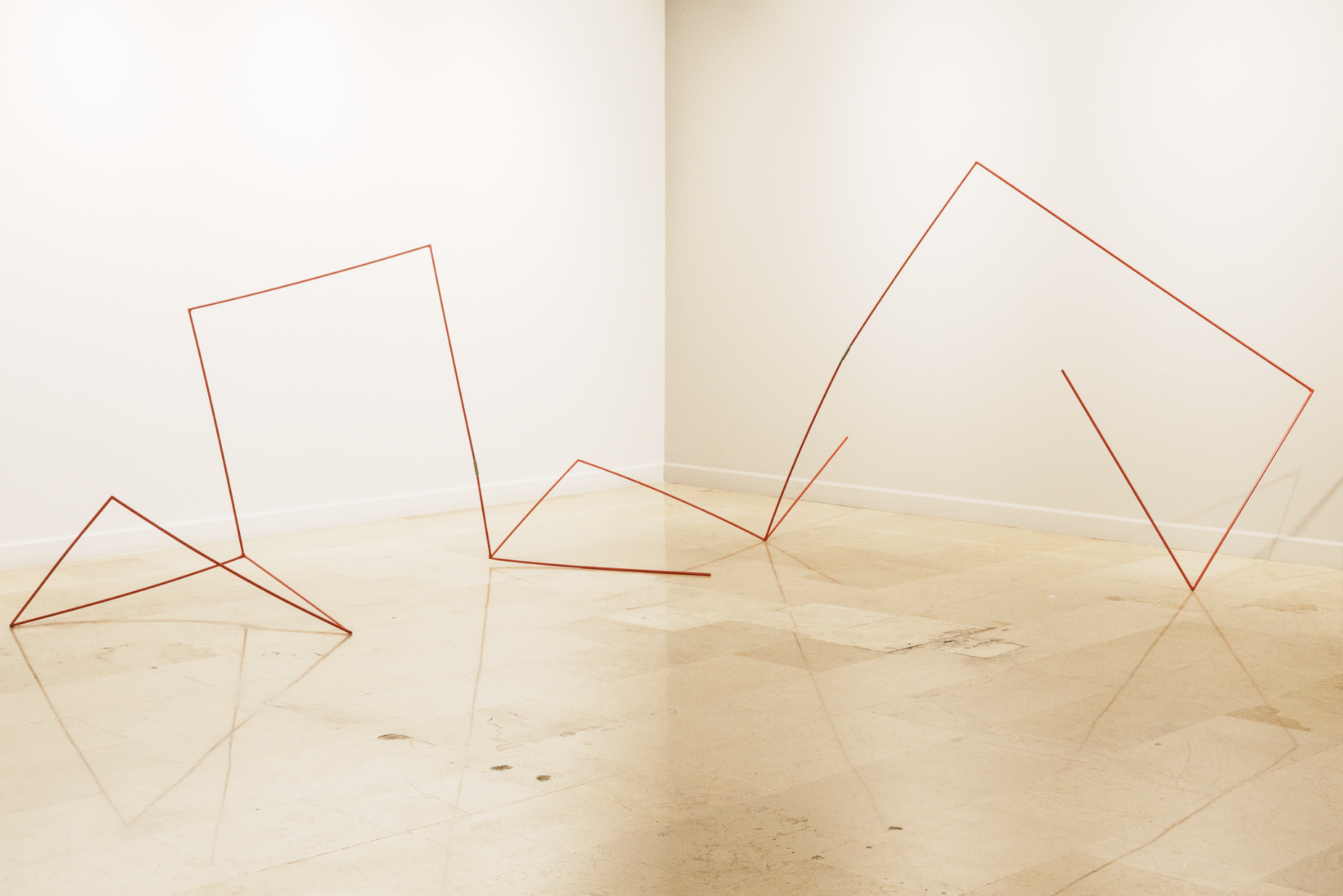
Void held an important place in your earlier work, while in this exhibition words also become part of your sculptures. What kind of relationship do you build between language and sculpture?
Nermin Ülker: Void still holds an important place in this exhibition. I always need emptiness. Human beings have developed different forms of expression in order to express themselves and be understood. Sign language and the Braille alphabet open ways of communicating through symbols and dots. We, too, use letters and lines.
For me, sculpture lets me invent a new language through forms and symbols. This language exists not only to tell but also to hide. Sometimes the way to express something lies not in making it entirely visible, but in leaving it incomplete or covering it.
You both reveal and cover the words in the works. Do you see covering as a way of protecting the word or of censoring it?
Nermin Ülker: For me, covering is a way of protecting the word, my privacy and my boundaries. Looking for privacy in words displayed in a public space may seem contradictory, even absurd. But making something visible does not mean exposing it completely.
The self-censorship that came with spending many years at boarding schools from the age of 11 became a way of behaving that I learnt in childhood and internalised over time. I gradually learnt which words I could say and which I had to keep to myself. Sometimes, by internalising pressure from outside, a person becomes their own censor.
The way I make the words visible in this exhibition while also covering them is connected to that experience. On the one hand I want to speak and be seen; on the other I want to protect what belongs to me. Covering is not only censorship for me; sometimes it is a way of protecting a word and setting my boundaries. Because what we hide is not always what we cannot say; it can also be what we want to keep for ourselves.
The exhibition focuses on the tension between visibility and privacy. Can a word that stays hidden also be a form of expression?
Filiz Ağdemir: Of course, hiding is a mode of expression the artist chooses deliberately. When she turns words into sculpture, she does not want to expose them. On the contrary, thanks to her formal choices, the sentences can be hidden within multidimensional surfaces, wide voids and a linear body. The word is there, concrete, made spatial, yet it cannot be made out.
This is exactly where the distinction between visibility and privacy becomes clear. What is visible in the sculptures is the word’s existence; what remains private is its content. There is something shared between artist and viewer. Words can come into being between the viewer’s witnessing and the artist’s privacy; it is a sharing in which boundaries are respected. Being able to separate the existence of a word from its content is, I think, the most delicate aspect of the exhibition. Being visible usually creates the expectation that everything must be revealed, but in fact distance is still possible. And without distance, the meaning in between cannot multiply.
What does placing the monuments directly on the floor, without plinths, add to the idea of the monument and to the relationship with the viewer?
Filiz Ağdemir: A monument is a form of memory sanctioned by society. A collective will decides which loss will be made visible and who will be mourned, and the monument proclaims that decision by raising it up. The artist does not wait for that decision; she forms the words in her own language and makes them monuments. Normally a plinth is used to monumentalise and elevate. The plinth separates the sculpture from the viewer and defines a distance from which it is to be looked at. As Rosalind Krauss pointed out, the more sculpture loses its base, the further it moves from the logic of the monument. Nermin Ülker’s sculptures stand in an interesting place here: they are both monuments and without plinths. How? Words that have found their place in their own bodies now belong somewhere. Yes, they have no plinths, because the words they carry were never raised up and never became a public voice.
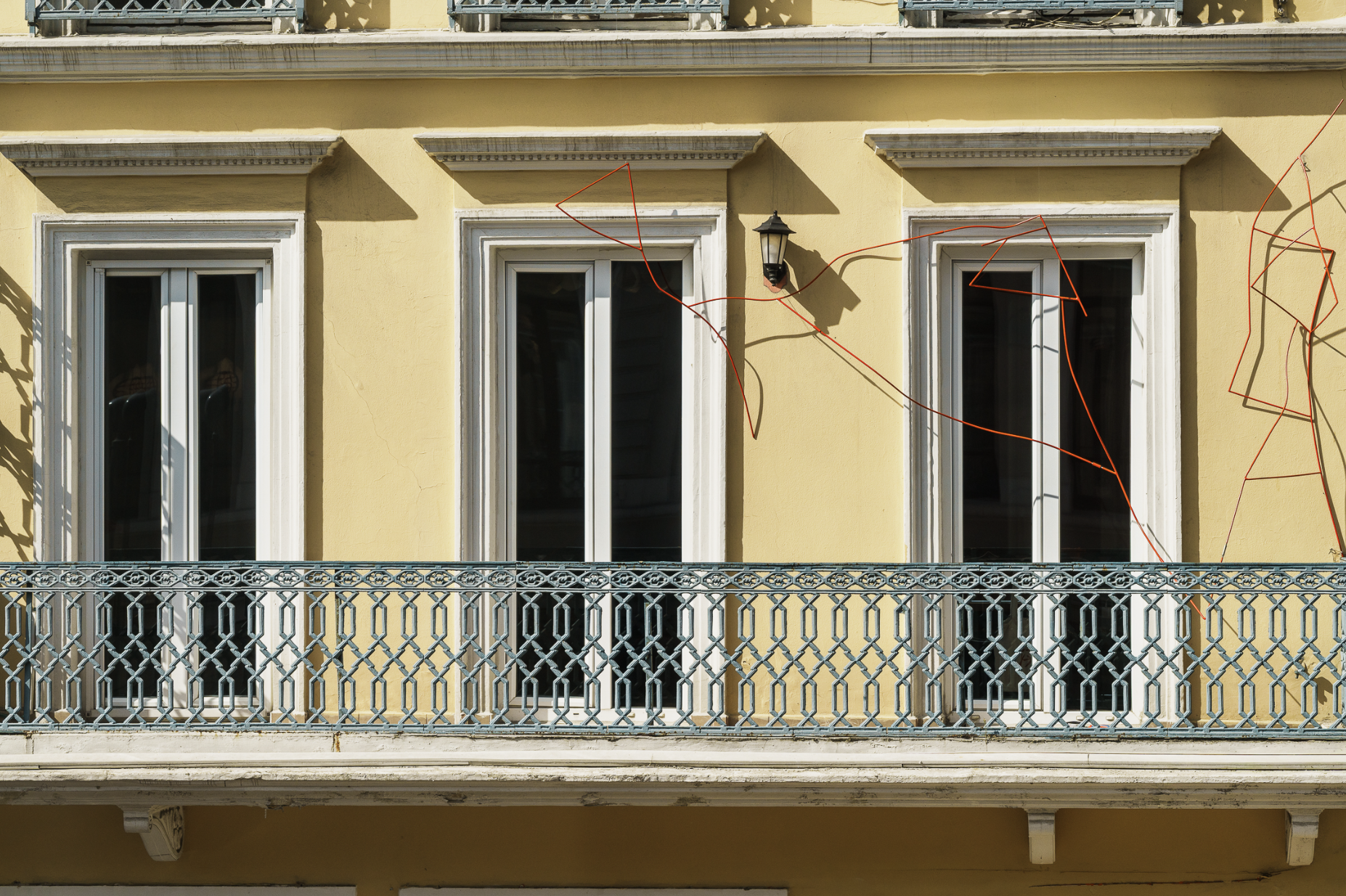
The viewer stands on the same ground as the sculpture; they do not look up at it but stand beside it and walk around it. This closeness also transforms the relationship with the word: the viewer is not facing a proclamation but standing next to a presence. The only work that breaks this horizontal, side-by-side arrangement is on the balcony. That piece did not (or could not) come inside; it climbs the façade overlooking the street. While the sentences inside stand at their own height, having found their place, this work waiting on the threshold carries the exhibition’s loudest voice.
You have worked with the artist before. Where do you see Nermin Ülker’s artistic language heading with this exhibition?
Filiz Ağdemir: For a long time, Nermin Ülker’s work has revolved around images of the home, the window, women and space, through metal and the relationship between void and solid. Metal constructions built with void first appeared in her previous solo exhibition, Gözün Kayıp Oyuğu. There, the void completed the form; parts that seemed missing were completed in the viewer’s mind.
In Dört Köşeli Üçgen the same formal language continues, but the role of the void changes: it no longer only completes the form, it hides the word. The word is there, producing new possibilities within the void. I don’t think this is a small shift; it is an important break within this formal language. In the exhibition the sculptures expand from image to word, and from word to space.
The home and the question of inside and outside have always been present in the artist’s work; this time the question moves out of the works and into the space itself. The way the balcony piece clings to the façade, the sculpture becoming part of the building, is very meaningful in this respect.