Roger Crowley: ‘The empire Portugal built was a product of its own poverty’
In his book “Deniz Canavarları”, Roger Crowley describes how Portugal built a lasting empire in the Indian Ocean with a small navy, how maritime trade transformed global relations of power, and where this process stands in the history of colonialism. We spoke to the author about the relationship between trade, military power and violence at the dawn of globalisation.
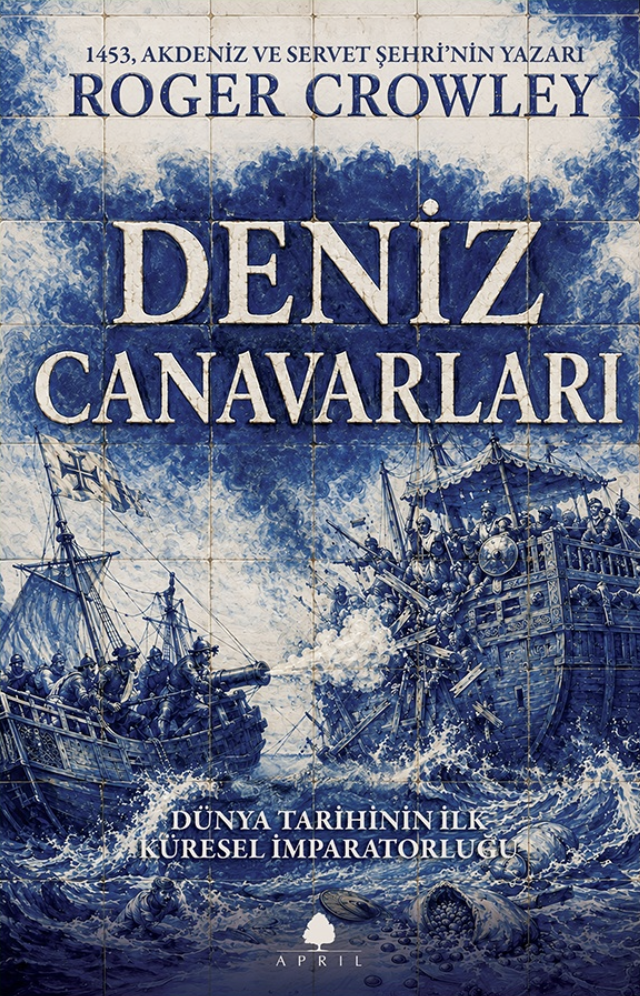
In his book Deniz Canavarları, Roger Crowley describes how Portugal built a lasting empire in the Indian Ocean with a small navy, and how maritime trade transformed global relations of power. Ranging from Zheng He’s vast Chinese fleets to the voyages of Vasco da Gama, the book examines a period in which the desire for a share of the spice trade was intertwined with the aim of spreading Christianity. Tracing the dominance the Portuguese established through strategic ports and fortresses, Crowley also places the violence on which this expansion rested at the centre of his narrative. In doing so, he shows how the sea routes that created lasting connections between continents became instruments of colonialism and forced subjugation.
We spoke to the author about the relationship between trade, religion and military power in the early days of globalisation, our changing view of the heroes of the age of exploration, and the legacy Portugal left to the colonial empires that followed.
You open the book with Zheng He’s vast Chinese fleets and then move on to Portugal’s much smaller navy. Why did Portugal manage to build a lasting empire while China withdrew from the seas?
China’s and Portugal’s approaches to maritime empire reveal two different mindsets. Zheng He’s fleet, which sailed the Indian Ocean in the early fifteenth century, was probably the most technologically advanced fleet the world had seen up to that time. The expedition was organised to display China’s power. Portugal’s few ships, by comparison, were a tiny force.
After Zheng He, China never again undertook such a display of naval power. The expedition had shown that China wanted nothing from the world. China saw itself as the Middle Kingdom; the idea of being at the centre ran deep in Chinese history and philosophy. Xenophobia was also part of this mindset: places beyond China were seen as the periphery, the provinces. In addition, China’s southern coasts were exposed to attacks by Japanese pirates, which strengthened the country’s tendency to turn inward.
Portugal, on the other hand, was a poor country with a small population and limited natural resources; so it always faced outwards, wanting everything it could get. The empire it built was a product of its own poverty. Portugal did not have enough manpower or resources to conquer and hold large territories. Instead, it built an empire of fortified bases controlling important trading centres and strategic waterways. In this way, with only a few thousand soldiers, it was able to control much of the Indian Ocean. This model of a light maritime empire was later adopted by other small seafaring powers such as the Dutch and the English.
Portugal’s search for a sea route to India combined the spice trade, the spirit of the Crusades and the desire to become a great power. Which of these weighed more heavily: economic interests or religious belief?
There was a tension between the desire to spread Christianity and trade. The Portuguese hoped to encounter Christian communities in the Indian Ocean, and this expectation was one of the reasons for the voyages. They sent small groups of missionaries to the East, with mixed results. They were most successful in Japan: it is estimated that they converted between 300,000 and 500,000 Japanese to Christianity before the Portuguese were expelled from the country. Many people also converted in Goa, the centre of the Portuguese empire in India. But on the whole, trade mattered more to the Portuguese in the Indian Ocean.
In the early sixteenth century there was an interesting dispute between Afonso de Albuquerque, the Governor of Goa, and the Catholic Church. Because only Portuguese men went to India, the Governor was worried about the problems that might arise between the Portuguese and local women. To prevent the danger of sexual violence, he wanted to encourage marriages between people of different races. The Catholic Church opposed this. Albuquerque ignored the Church and carried out his plan. Marriages between different communities helped build more harmonious relations with the local population and helped trade to flourish.
For centuries Vasco da Gama was remembered as a great explorer. Yet your book also describes extremely brutal acts, such as the burning of the Miri, a ship carrying Muslim pilgrims. Should we remember da Gama as a heroic explorer, or as one of the founders of imperialist violence?
Da Gama was a man of his time, with an anti-Islamic mindset reminiscent of the Crusades. The burning of the Miri was a consequence of this. Our view of the great explorers has certainly changed over the last century. A hundred years ago da Gama, like Columbus, was celebrated as a great and heroic figure. Today, opinion on da Gama and Columbus is sharply divided over whether they were heroic explorers or oppressors of indigenous peoples. These figures have become part of the culture wars of our century, and attitudes towards them continue to shift. In Portugal, da Gama remains an important figure in the national story.
When the Portuguese entered the Indian Ocean, they encountered a sophisticated, cosmopolitan and relatively open trading system. How were a few thousand Portuguese able to impose their rules on societies far larger and richer than their own?
The Portuguese realised very quickly that controlling the whole of the Indian Ocean was impossible; instead, they identified the key strategic ports and waterways. They had also arrived in a sea where firearms were not widely used, one that was largely peaceful and based on free trade. Their strategy was to seize and fortify the critical choke points. This fortress strategy was extremely successful. Because there were no cannon in the region, the Portuguese were able to build a network that controlled the Indian Ocean.
Francisco de Almeida wanted to establish Portuguese power with a mobile navy. Afonso de Albuquerque, by contrast, envisaged a lasting empire built around fortresses, ports and strategic sea routes. Which strategy did more for Portugal’s success?
Almeida’s idea was not workable. Controlling the vast expanse of the Indian Ocean would have required an enormous navy. The pattern of the monsoon winds would also have limited a mobile fleet’s ability to manoeuvre. What proved more successful was Albuquerque’s strategy, based on fortresses and strategic sea routes. He saw that it was possible to control the entire sea with a few thousand soldiers holding the critical choke points from well-fortified strongholds.
Your book describes how the Portuguese relied not only on superior naval artillery but also on systematically spreading fear. Were massacres, mutilations and the bombardment of cities deliberate tools of empire, or the consequences of wars that spiralled out of control?
Although in some cases atrocities and massacres stemmed from the rage of a single commander, violence was certainly used more or less deliberately to subdue and intimidate peoples and ports. Albuquerque was the one who applied this method most effectively.
The Portuguese violently overturned the existing trading system, but they also built the first lasting global network linking distant continents. Should we, then, regard the Portuguese Empire as the beginning of modern globalisation, or as the first great laboratory of European colonialism?
It is hard to separate the two. The Portuguese were the first to build global networks; these networks allowed plant species, foodstuffs and animals to be carried between continents. Small seafaring states such as the Dutch and the English followed the model they established. These networks made connections across the entire planet possible. The long-distance exchange of goods also included plants and foodstuffs; genetic material was carried to every corner of the world. But there was a dark side too: the spread of disease, the forced enslavement of millions of people, and colonialism.