The ortolan ritual: why did diners hide their faces?
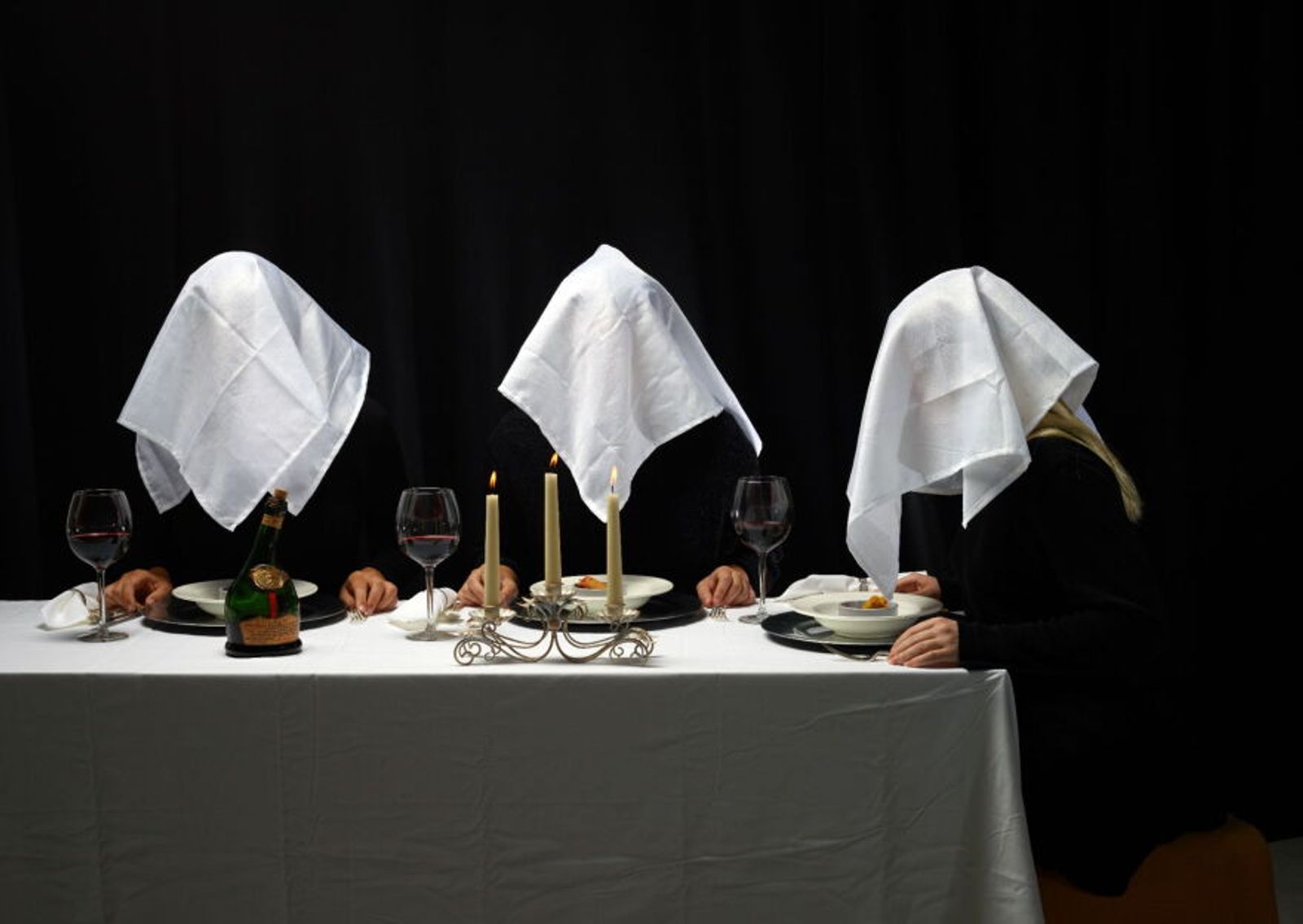
Eaten bones, organs and all, the ortolan is one of the most controversial dishes in French gastronomy. Its story, which stretches from Dumas’s culinary dictionary to “Succession”, raises the question of the suffering inflicted on animals for a single mouthful of pleasure, while the napkin traditionally draped over the head when eating ortolans prompts another question: why do we hide when we eat?
Alexandre Dumas, in his famous work Grand Dictionnaire de cuisine (published in Turkish as Mutfak Sözlüğüm by Oğlak Yayınları), recounts a dialogue between a hunter and a poet. The poet Antoni Deschamps asks whether we have the right to kill birds that harm no one and that delight us with their looks and their song. For the hunter, the answer is simple: “If we are going to eat them, we can kill them.” “Ortolans too?” asks Deschamps. “With great pleasure, if they are well cooked.”
Whether the poet was persuaded by this logic is unknown, but Dumas reports that when an ortolan was set before Deschamps, he could not stop himself from eating it. Nor is he alone: the admirers of this little bird, which the celebrated chef Alain Ducasse described as “a folly fit for princes, whose price one should be willing to pay at least once in a lifetime”, include many well-known figures, from Napoleon III to François Mitterrand.
Witnessing the happiness people feel while eating this dish, which French chefs describe as “delicious enough to lead you happily to your death”, is another matter. In the ritual of eating ortolan, the diner, who swallows the bird bones, organs and all, covers their head with a large napkin. In this controversial ritual, which you may have come across in Succession or The Taste of Things, some say the napkin is there to keep the aroma in, while others say it hides the shame of the act from God...
What is the ortolan, and how is it prepared?
The ortolan, whose scientific name is Emberiza hortulana, is a migratory songbird of the bunting family. In Türkiye’s bird lists it appears under the name “kirazkuşu”; the name “bayağı kirazkuşu” is also used. First classified by the Swedish naturalist Carl Linnaeus, this tiny bird, 16-17 cm long and weighing 20-25 grams, is at the centre of a controversy far larger than its size would suggest...
Ranked among the most luxurious and expensive dishes of French cuisine since the 18th century, and still known today as “the dish of God and millionaires”, these little birds are prepared in a way that, by most accounts, is hardly appetising. Associated with the south-western regions of France, the birds are caught during migration, kept in the dark and fattened on carbohydrate-rich foods such as figs, grapes and millet. They are then drowned in Armagnac, a French brandy; after being left in the brandy for a while, they are plucked and cooked whole in a hot pan or in the oven.
At the table, they are traditionally eaten in a single mouthful, bones and organs included. The only part left behind is the beak. The bird is usually held by the beak and bitten feet first, and the beak is then removed.
What lies beneath the napkin?
From the earliest days of its popularity, eating ortolan has represented one of the grey areas of French gastronomy. Setting aside the status attached to the dish, those uneasy that the pleasure taken in an animal killed so painfully had been turned into a show developed a ritual that, in a sense, covered up this shame. Those about to eat the bird began covering their heads with a thick napkin or tablecloth so that no one could see the moment the food went into their mouths.
One of the most frequently repeated explanations is that the diner is trying to hide the shame of what they are doing from God. But there are more practical explanations too. In a television programme broadcast in 2006, for instance, Alain Juppé explained that the napkin serves both to keep the aromas in and to hide from others’ eyes the sight of someone chewing a whole bird, bones and all.
The ritual has also featured in some world-famous productions. In the sixth episode of the first season of Succession, for example, we saw Tom Wambsgans teaching Greg Hirsch the ortolan ritual as one of the strange tests he must pass to be accepted into the world of the rich.
Likewise, we have seen references to the ritual in Hannibal, Billions, The Taste of Things and even the popular comedy series Brooklyn Nine-Nine.
Privacy at other tables
Hiding the act of eating from the eyes of others is not unique to the ortolan ritual; it is a habit that appears in different eras and places. At the ancient Persian court, for example, the king usually ate alone. According to Heraclides of Cyme, even the guests entertained inside did not sit in the same room as the king but ate in the room opposite. The king could see them from behind the curtain at the door, but they could not see him.
Similar rules appeared in 19th-century travellers’ accounts of the kingdoms of West and Central Africa. Seeing the king of Loango eat or drink was punishable by death. When the king took his drink, an attendant rang a bell and everyone in the room threw themselves face down on the ground. When the king of Dahomey had to drink in public, he stepped behind a curtain or handkerchiefs were held up around his head.
In these societies the reasoning rested on a magical fear. It was believed that the soul could escape through a mouth opened to eat, or that evil forces could enter. Tuareg men of the Sahara, meanwhile, covered the lower part of the face with a veil called the tagelmust, considering it shameful to show their mouths to strangers or to people of higher rank.
A similar custom prevailed at the Ottoman court. Under rules that remained in force for centuries after Fatih Sultan Mehmed (Mehmed the Conqueror) abolished, in his code of law, the custom of the sultan eating at the same table as others , sultans sat down to eat only in the presence of their servants and their own families.
This preference can be explained by the wish to preserve the ruler’s unreachable position. The intimacy created by sharing a table, and the human weaknesses that might be glimpsed during a meal, could have narrowed the distance between the sultan and his statesmen. The risk of poisoning was also an important reason. Some writers added one more: keeping such human acts as chewing and swallowing out of the statesmen’s sight, and preserving the sultan’s aura of untouchability.

The price of a tradition
To return to the ortolan: today the bird is protected across Europe under the EU Birds Directive of 1979. France added the species to its list of protected birds in 1999, banning its capture, killing and sale. For many years, however, the ban remained on paper.
Opponents of the ban in the gastronomic world wanted this culinary tradition preserved. In 2014, chefs including Alain Ducasse and Michel Guérard asked for an exemption of one day or one weekend a year, so that the tradition and the culinary knowledge tied to it would not be lost; their request went unanswered.
Meanwhile, hunting continued despite the ban. According to a study published in Science Advances in 2019, carried out by 30 researchers at the request of the French Ministry of Ecology, about 30,000 of the roughly 300,000 ortolans passing through south-western France each autumn, or one bird in ten, were being caught illegally. Using small tracking devices fitted to the birds, feather analysis and genetic testing, the researchers showed that a third of these birds came from northern populations, in the Baltic states, Finland and Scandinavia, that were already shrinking fast.
This finding, which demolished the hunters’ defence that “what we catch is only a small part of the population”, also showed that the northern populations faced a direct threat of extinction. The warning of the study’s lead author, Frédéric Jiguet, was clear: “If ortolan hunting continues, it will be the end of the ortolan.” According to the model, even a complete halt to hunting would only double the species’ chances of survival, without guaranteeing it.
One reason is that the risks facing the ortolan are not limited to hunting. The species’ population in Western and Central Europe fell by 82 per cent between 1980 and 2008; as a breeding bird it has almost entirely disappeared from Belgium, the Netherlands and Switzerland. The intensification of agriculture, habitat loss and climate change are among the main causes of this collapse. Hunting is the final blow that pushes already weakened populations over the edge.
In recent years, however, the picture has slowly been changing. Since 2016, hunters living in the Landes, in south-western France, have been convicted one after another, and in rulings in 2018 and 2019 France’s Court of Cassation confirmed that the “tolerance” defence the hunters relied on had no legal basis. The Committee Against Bird Slaughter, which has been searching the area for traps since 2011, reports that the number of active trapping sites it has found has fallen by more than 90 per cent.
Even so, ortolans still find buyers on the black market for hundreds of euros apiece.