
Aposto World · 24 February 2025
AK Party holds congress, showcases MP transfers
Amid expectations of reform and renewal, the AK Party held its 8th congress. While many key figures retained their positions, local party organizations and the extended party list saw significant changes.
By Alp Akiş
Turkey's ruling AK Party held its 8th regular party congress in Ankara, where President Erdoğan was unanimously reelected as party leader as the sole candidate.
Hundreds of delegates cast their votes to reshape the AK Party’s leadership, electing members to its influential Central Decision and Executive Board (MKYK) and Central Executive Board (MYK). The candidate list for the MKYK included 75 names, blending seasoned party veterans with notable newcomers. Among them were economist Abdülkadir Develi, former football star Mesut Özil, who previously chose to represent Germany’s national team, and Kürşad Zorlu, a lawmaker who recently defected from the opposition İYİ Party. Long-serving figures like Erkan Kandemir, a key congress organizer and AK Party deputy chair, and Eyyüp Kadir Inan, former head of the party’s youth wing, also featured prominently.
- Of the candidates, 39 were fresh faces, including 7 members of parliament who switched allegiance from opposition parties over the past year, and 29 were current AK Party parliamentarians.
The congress unveiled three new MYK boards dedicated to relations with Turkic states, health policies, culture and arts, raising the number of deputy chairs from 16 to 19.
Erdoğan framed the event as the culmination of a renewal process sparked after last year’s municipal election upset, which saw the party lose key strongholds and nearly every major city. Provincial congresses launched last autumn paved the way, with nearly three-quarters of provincial chairpersons and two-thirds of district leaders replaced in an effort to restore confidence in the party.
“The AK Party has continuously succeeded in renewing, changing, developing, and elevating itself,” Erdoğan told the crowd, pointing to its 24-year dominance in Turkish politics since its founding in 2001. He boasted that the party ranks among the top five globally in membership, underscoring its grassroots strength.
AK Party, with open arms
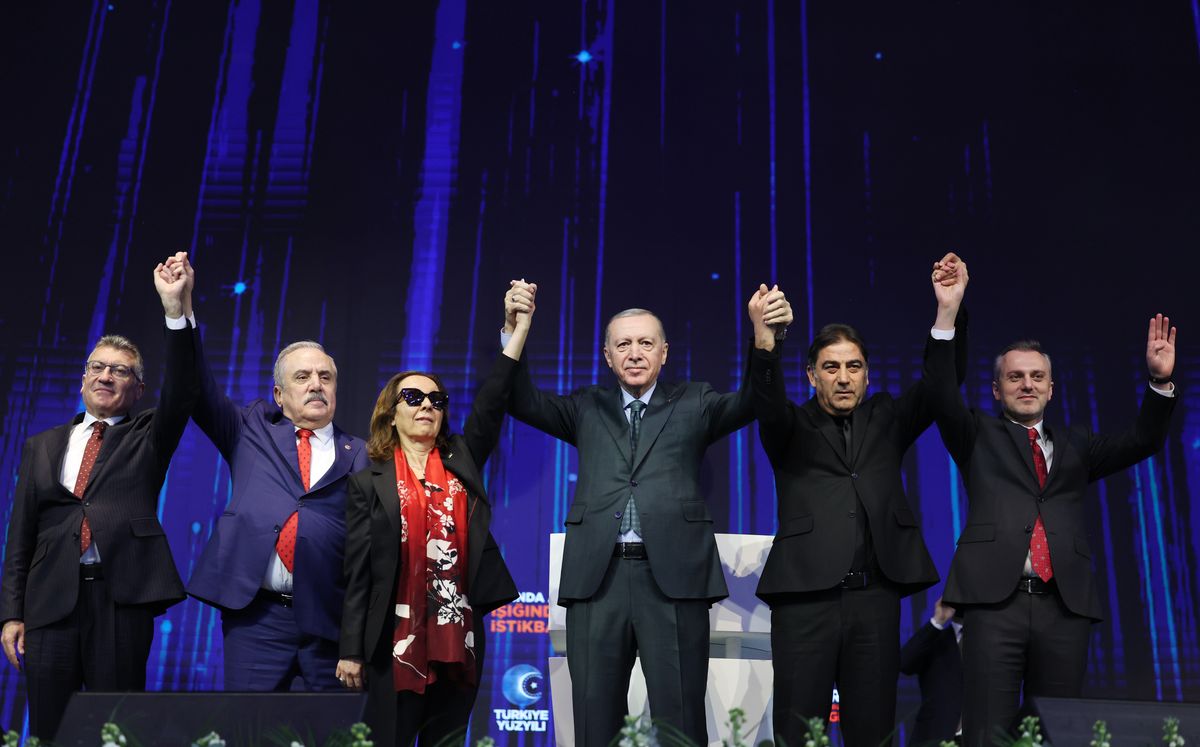
The congress also served as a platform to showcase high-profile defectors from rival parties, underscoring the AK Party’s ability to co-opt opposition figures and former critics. Among those officially inducted were former football coach Ünal Karaman, veteran politician Mehmet Salim Ensarioğlu, and constitutional scholar Serap Yazıcı Özbudun—who resigned from the Gelecek Party just a day earlier. In a symbolic display of unity and loyalty, they posed alongside Erdoğan.
- These defections drew criticism from constituents of the parties the MPs were originally elected from. Voters expressed their disappointment on social media, directing their anger at the MPs for running under opposition parties only to defect to the ruling AK Party after being elected.
The AK Party’s ultranationalist ally, MHP, sent a delegation, while its leader, Devlet Bahçeli—sidelined by surgery—symbolically marked the occasion with a lavish floral tribute. His gift included 1,071 roses (a nod to the Battle of Manzikert, which initiated the Turkification of Anatolia), 1,453 clovers (symbolizing the Ottoman conquest of Constantinople, now Istanbul), and 23 orchids representing the AK Party’s 23 years in power. In contrast, the main opposition CHP maintained a low profile, sending only two deputy chairs.
Reactions
Rumors had long circulated that the AK Party—having lost key municipalities in the local elections and fallen behind the CHP in overall vote share—would undergo significant staff changes amid growing unrest within the party.
Following the local election setback in March, Erdoğan launched a party-wide restructuring, beginning at the local level by replacing nearly 75% of provincial presidents during provincial congresses. It was widely speculated that this shake-up would extend to the party’s central leadership, bringing changes to key positions. However, these expectations did not materialize.
Journalist Gökçer Tahincioğlu notes that AK Party congresses, unlike those of most political parties, are typically concluded with remarkable speed. This congress was no exception—there was not a single dissenting voice, no objections to the candidate lists, and all attention was focused on President and AK Party Chairman Recep Tayyip Erdoğan's speech and the list approved by him. As expected, Erdoğan replaced more than half of the 75-member Central Decision and Executive Board (MKYK), the party’s main decision-making body. In the Central Executive Council (MYK), 39 new names were introduced, while 36 members retained their seats. Meanwhile, 17 of the 18 members of the Central Executive Committee were re-elected from within the committee.
Bottom line: Defying expectations of reform, Erdoğan reiterated his usual rhetoric at the congress. Meanwhile, Erdoğan and the AK Party took another step toward their goal of weakening the opposition and consolidating their ranks in preparation for a new constitution and potential early elections.