
Aposto World · 7 April 2025
The Palestine exception to academic freedom: What is happening in US universities?
The dismissal of historian of the Ottoman Empire Cemal Kafadar from his position as Director of Harvard University's Center for Middle Eastern Studies, and the detention of Rümeysa Öztürk, a PhD student at Tufts University in Massachusetts, are the latest links in a chain that began in the pre-Trump era at US universities, which sees Palestine as an “exception” to freedom of expression and academic freedom. What is happening at US universities?
By Deren Ertaş
On March 25, Rümeysa Öztürk, a Turkish national and PhD student and Fulbright scholar at Tufts University, was on her way to iftar dinner when several masked individuals stopped her on the street. They informed her that they are from Immigration and Customs Enforcement and that she was in the country illegally. Öztürk’s shock and confusion at the arrest can be seen from the CCTV recording of the event, which also shows the agents handcuffing her before taking her away.
“A visa is a privilege, not a right,” said U.S. Department of Homeland Security spokesperson Tricia McLaughlin after the arrest.
“Department of Homeland Security and Immigration and Customs Enforcement investigations found Ozturk engaged in activities in support of Hamas, a foreign terrorist organization that relishes the killing of Americans. Glorifying and supporting terrorists who kill Americans is grounds for visa issuance to be terminated. This is common sense security.”
On March 24, 2024, almost exactly a year before her arrest, Öztürk had published a co-authored op-ed in the Tufts Daily criticizing the University’s response to a student group’s demand for divestment from companies tied to Israel. On March 25 of 2025, she was taken to a detention facility in Louisiana.
A wave of arrests in American universities
Öztürk’s case was only the latest in a wave of detainments that swept American universities last month. It all began on March 8 when authorities detained Mahmoud Khalil, a Palestinian activist and recent Columbia graduate, at his apartment where he lived with his eight-month pregnant wife. Unlike Öztürk, who was in the US on a student visa, Khalil is a permanent resident with a green card. Like Öztürk, he had spoken out against the ethnic cleansing of Palestinians. He was a spokesperson for Columbia University Apartheid Divest and acted as a mediator between the group and the university during the wave of protests in Spring 2024.
- Both of their cases are currently pending court decisions, but one thing is clear: The Trump government will use any means available to eradicate pro-Palestine voices from university campuses.
One of those means is intimidation. On March 7, the White House announced that it cut 400 million dollars in federal funding for scientific research at Columbia University. One week later, the university received what one scholar has called a “ransom note,” saying that the university may recover the funds if they put the Middle Eastern, South Asian, and African Studies Department and the Center for Palestinian Studies under “academic receivership” for five years.
Important note: Academic receivership is a relatively rare event in which a departmental chair is imposed from the outside by a dean or provost when the department is judged unable to govern itself effectively. On March 20, the Columbia administration acquiesced.
Five days later, at Harvard University, Cemal Kafadar, Vehbi Koç Professor of Turkish Studies and the Director of the Center for Middle Eastern Studies (CMES) had a meeting with the Interim Dean of Social Sciences, David Cutler. He learned that he was to be dismissed from his role as the Director of the CMES. A day later, on March 26, Rosie Bsheer, Frederick S. Danziger Associate Professor of History and Associate Director of the CMES, had a similar meeting with Cutler, which ended with the termination of her role.
Cutler cited the complaint made by some Harvard affiliates who alleged that the CMES failed to represent multiple perspectives in some of their programming. Over the last year and a half, the CMES hosted speaker series that brought Palestinian and Israeli scholars to campus, and programmed events that offered a range of perspectives on the situation in Gaza and the West Bank, as well as the conflicts in Lebanon, Sudan, and Syria.
The Palestine exception
The Palestine exception to academic freedom and free speech was already par for the course in U.S. academia long before Trump took office. Since the start of Israel’s most recent assault on Gaza, which has been ongoing since October 2023 and has killed over 50,000 people, students across the United States have risen up against the ethnic cleansing of Palestinians. They demanded that the U.S. government negotiate a ceasefire and their universities divest from investments that directly supply arms to Israel.
Additionally, they called for creating institutions that support research and teaching on Palestine, which, although one of the most popular topics, is among the least taught. They occupied campuses and put up tents, creating the encampments that made the news. These encampments were spaces where students with different faiths and political convictions gathered to learn about Israel and Palestine, share perspectives, show solidarity, and protest university policies.
The government and universities responded with brute force. In April 2024, hundreds came together on Columbia University’s campus to excercize their constitutional right to protest. More than 100 demonstrators were arrested with the authorization of then-president Minouche Shafik. Students across the country have been suspended, expelled, faculty dismissed from posts, and many individuals left vulnerable to threats from extremist organizations.
At many institutions, including Harvard, students and faculty with pro-Palestinian views have been doxed, their names put on trucks with the headline, “Harvard’s Leading Antisemites,” or named on Canary Mission, a doxxing website that blacklists students, professors, and organizations with anti-Zionist and pro-Palestinian views.
“I’ve been doxed by Canary Mission twice,” said a professor (who would like to remain unnamed) who was working at Columbia last year:
“They used AI recognition to identify me from a photograph in which I’m standing next to the student encampment. We had gone there as faculty to protect our students from NYPD storming their encampment.”
She added that the recent doxxing campaigns resulted in her receiving death and rape threats and over four thousand emails to her employer, as well as to the local government and the White House.
“Most of the emails I received were racist, and truly vile,” she said. “One even called me a jihadist slut.”
Since January 2025, universities have taken this moment to implement even more aggressive policies. “Organizers on the ground and students here generally feel that the Board of Trustees is taking advantage of the new Trump era to achieve the policies that it was already trying to enact,” said Sarah, a PhD Candidate at Columbia University, student organizer, and member of Student Workers of Columbia. Referring to the members of the Columbia Board of Trustees who have ties to the weapon manufacturer Lockheed Martin, the investment firm BlackRock, and the pro-Israel lobbying group American Israel Public Affairs Committee, Sarah said,
“These are people with vested interests in war profiteering and genocide of Palestinians. So, it makes sense that they would look for an opportunity to achieve their agenda, and they just got one.”
A similar feeling permeates Harvard. The dismissal of Kafadar and Bsheer came days before the Trump administration threatened to cut nearly 9 billion dollars of funding for research with the reasoning that the university had not done enough to curb antisemitism on campus.
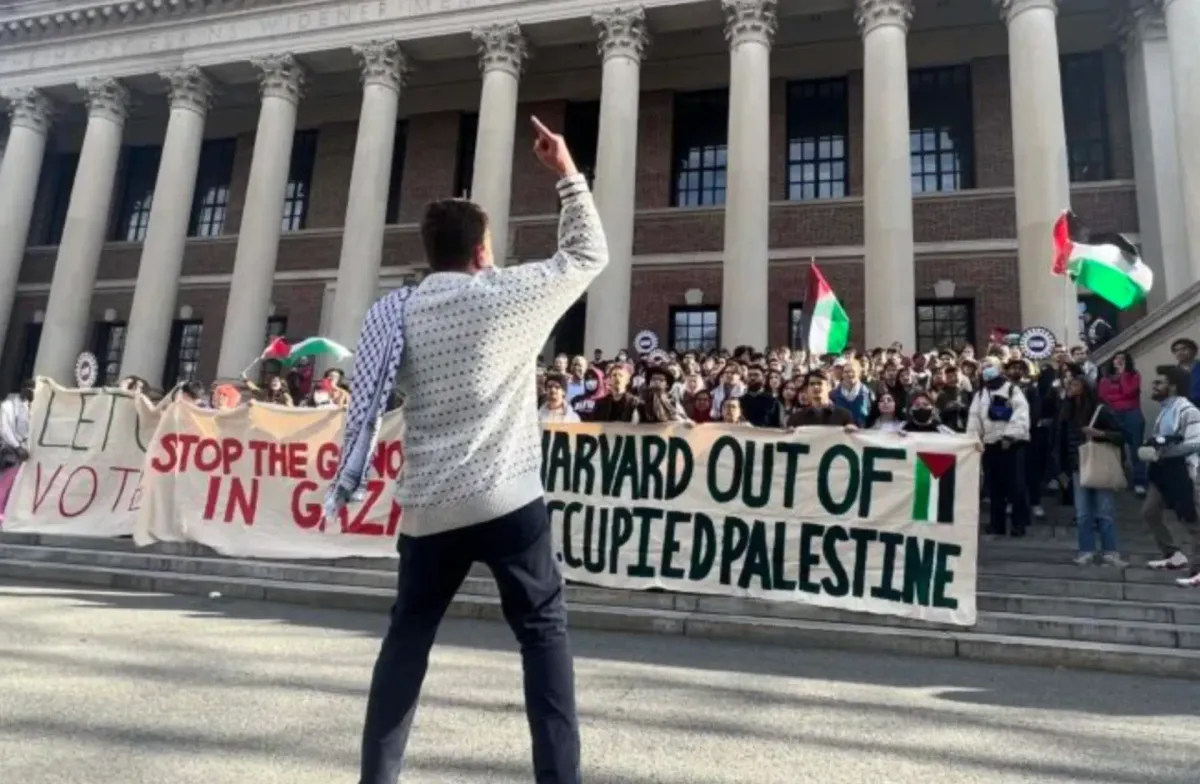
Around the same time, the Harvard School of Public Health paused its research partnership with Birzeit University in Ramallah, West Bank. This week, the university also suspended the Religion, Conflict, and Peace initiative at the Harvard Divinity School, which organized yearly trips to Israel and the West Bank. A spokesperson for Harvard Out of Occupied Palestine, a student-run organization, held that “As President Donald Trump’s fascist policies accelerate surveillance and violence across the U.S., it is Harvard’s responsibility, as a powerful site of knowledge production, to support rigorous scholarship across disciplines. Instead, the Harvard administration has preemptively capitulated to pressure with the aims of protecting itself.”
“It’s a lot of money,” says Nizar Farsakh, a graduate of the Mid-Career Program at the Harvard Kennedy School and Lecturer at the Elliott School of International Affairs at George Washington University.
“They use it in a lot of programs. You can understand the administration’s position that it will not risk closing very important programs and initiatives just to respect the freedom of speech. It’s not what universities are supposed to do, but from their perspective it’s understandable.”
One of the ways that the Trump administration tries to keep Harvard in line is to paint it as a breeding ground for progressive thought and radicalism. For Farsakh, that could not be farther from the truth. “Harvard is not a progressive place, it’s especially conservative. It follows power, that’s where its bread and butter is.”
Following the Trump administration’s threat to cut funding, Harvard University president Alan Garber sent an email to members of the Harvard community stating that the university had “devoted considerable effort to addressing antisemitism” in the last fifteen months. One of those efforts was the adoption of the International Holocaust Remembrance Alliance definition of antisemitism. It is a controversial definition of antisemitism that, as many Israeli and international civil society organizations have repeatedly warned, “has often been used to wrongly label criticism of Israel as antisemitic, and thus chill and sometimes suppress, non-violent protest, activism and speech critical of Israel and/or Zionism, including in the US and Europe.”
According to Walter Johnson, Winthrop Professor of History and Professor of African and African American Studies at Harvard, “The line of accusation that defines any criticism of Israel as antisemitic and suggestive of support for terrorism is as ridiculous as it is dangerous to the security of the United States.”
Many feel that Harvard is caving under pressure from an increasingly authoritarian government. At a faculty meeting on April 2, Harvard Faculty of Arts and Sciences Dean Hopi E. Hoekstra defended the decision to dismiss Kafadar and Bsheer from their administrative roles within the CMES to a room of concerned faculty members. Outside, nearly three hundred students rallied against the dismissals. In retaliation, the university administration announced on Wednesday that it banned the Palestine Solidarity Committee, an alliance of student groups, from further events until the end of the school year.
The Harvard University chapter of the American Association of University Professors released a statement on March 31, saying “These terminations violate the principle of academic freedom at the heart of our institutional mission and set a bleak precedent for free inquiry and expertise at the university.” On the same day, the Middle East Studies Association’s leadership wrote a letter addressed to Garber, Hoekstra, and Cutler, saying “Harvard’s decision to remove Professors Kafadar and Bsheer violates its own avowed commitment to freedom of speech and academic freedom.”
- Both of these letters called for the university to immediately reinstate the leaders of the CMES. A similar call was echoed in a statement penned by students affiliated with the CMES and signed by over 200 graduate students at Harvard.
As Rümeysa Öztürk and Mahmoud Khalil, and numerous others, wait for decisions to be made on their deportation cases, non-U.S. nationals on American campuses are concerned about their futures. Universities issued warnings that international students should avoid travel during the Summer break since they may not be let back into the country. The Trump government has made it clear that their social media profiles and engagements are being watched.
Academic freedom and the freedom of speech are being compromised on U.S. campuses. In this climate of fear, learning has become difficult.