





Öcalan urges PKK to disarm in historic call

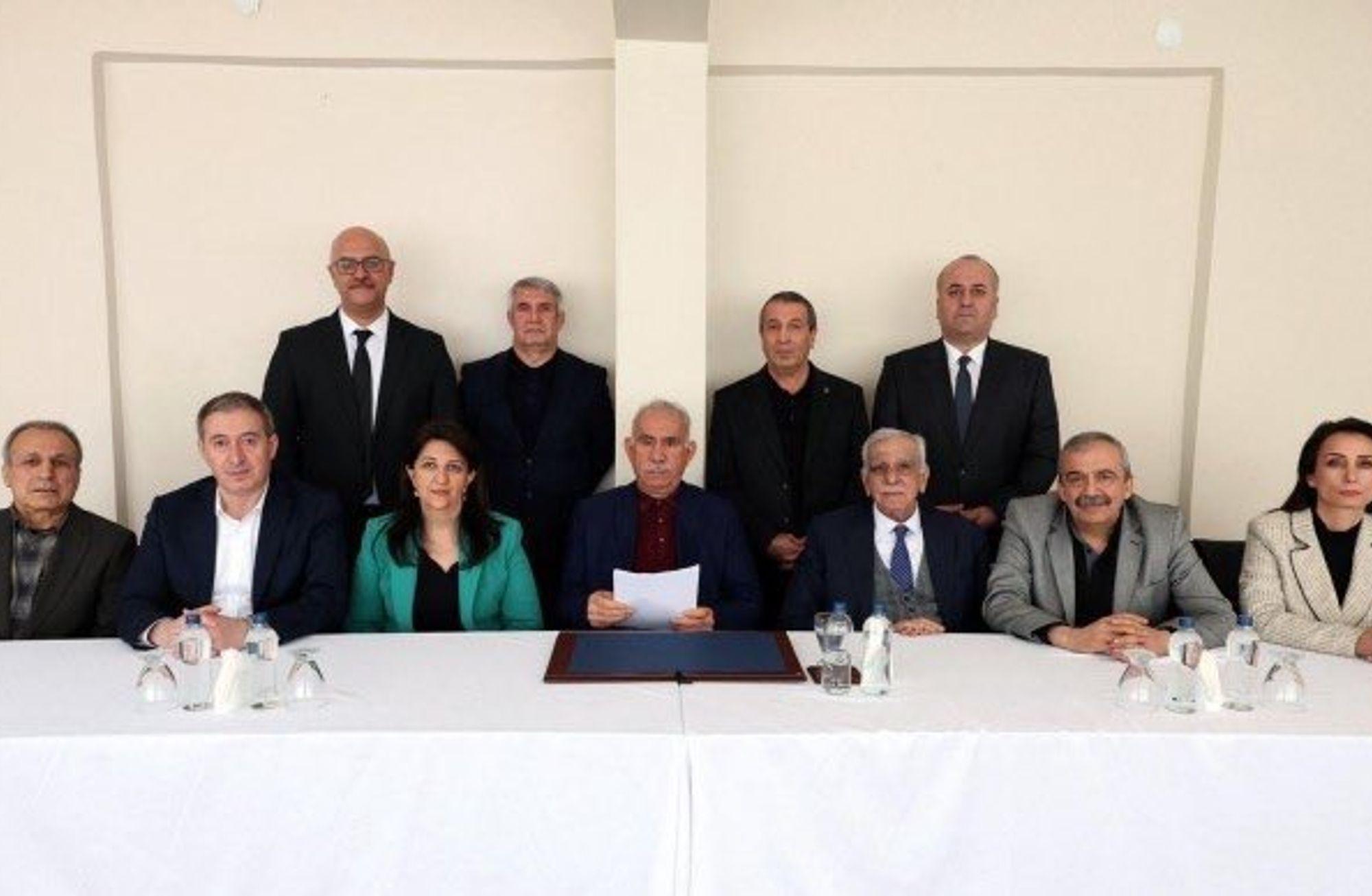
DEM Party held a press conference on Thursday, following a third visit to İmralı Island—where PKK leader Abdullah Öcalan is jailed—to share with the public Öcalan's long-awaited call for the PKK to lay down arms.
The DEM Party delegation related Öcalan's words first in Kurdish and then in Turkish. As expected, Öcalan called for the PKK and its offshoots to lay down arms and disband.
The importance of the call cannot be overstated: the PKK is the longest-running armed insurgency in Turkey and has carried out terror attacks that have killed hundreds for over four decades.
Some background: The PKK is recognized as a terrorist group by Turkey, the US, the UK, and the EU, among others. Öcalan, the group's leader, has been held in near-total isolation on the prison island of İmralı since 1999, with only rare communication with the outside world
How did we get here?
On the first day of the new legislative year, October 1, nationalist MHP leader Devlet Bahçeli shook hands with DEM Party MPs—a highly unusual gesture coming from a senior politician who has branded the Kurdish political movement as terrorists or terror supporters for decades.
Bahçeli took the stage for his party's parliamentary meeting on October 22 and made a statement no one saw coming: he called for jailed PKK leader Öcalan's solitary confinement to end and for him to take part in a peace process that would end the decades-long clashes between the Turkish military and Kurdish armed forces.
Only a few days after Bahçeli's unexpected speech, Öcalan was granted a visit for the first time in 43 months to meet with a family member on İmralı Island, where he is jailed. His nephew, an MP for the DEM Party, related Öcalan's reply to the recent developments:
"The solitary confinement is still in effect. If the necessary conditions are met, I theoretically and practically capable of carrying this process from a platform of conflict and violence to one of law and politics."
Over the past few months, a delegation from the DEM Party visited Öcalan on three occasions: December 24, January 22, and today, February 27. In between these visits, the delegation met with other political parties, organized grassroots meetings, and engaged with local and international actors, including the Kurdistan Regional Government (KRG) in Iraq. The delegation also visited jailed Kurdish political leaders such as Selahattin Demirtaş and Selçuk Mızraklı.
Why now?
Among political analysts and the general public, two scenarios have gained traction in explaining the governing right-wing coalition’s sudden shift in narrative on the Kurds.
- New constitution: Erdoğan and his coalition have been vocal for months about their desire to draft a new constitution. The coalition lacks the parliamentary majority to achieve this without some support from the opposition. Gaining parliamentary support or public endorsement through a referendum could help achieve this goal, and reconciling with the Kurds could be a means to this end.
- Geopolitics: There have been major paradigm shifts in the Middle East in the past few years: The end of Syria's civil war, US withdrawal from Iraq and Afghanistan, Iraq and the Kurdistan Regional Government, and of course, Israel's war with Iran-allied "Axis of resistance" that diminished Iran's regional influence to an extent. These set the scene for a number of ways in which its Turkey's national interest to increase political engagement with the Kurdish movement.
The statement
Below is the complete text of Öcalan's call, as related by members of the DEM Party delegation:
"Call for Peace and Democratic Society
The PKK was born in the 20th century, in the most violent epoch of the history of humanity, amidst the two World wars, under the shadow of the experience of real socialism and the cold war around the World. The outright denial of Kurdish reality, restrictions on basic rights and freedoms—especially freedom of expression—played a significant role in its emergence and development.
The PKK has been under the heavy realities of the century and the system of real socialism in terms of its adopted theory, program, strategy and tactics. In the 1990s, with the collapse of real socialism due to internal dynamics, the dissolution of the denial of Kurdish identity in the country, and improvements in freedom of expression, led to weakening of the PKK´s foundational meaningfulness and resulted in excessive repetition.
Throughout the history of more than 1000 years, Turkish and Kurdish relations were defined in terms of mutual cooperation and alliance, and Turks and Kurds have found it essential to remain in this voluntary alliance to maintain their existence and survive against hegemonic Powers.
The last 200 years of capitalist modernity have been marked by primarily with the aim to break this alliance. The forces involved, in line with their class-based interests, have played a key role in furthering this objective. With monist interpretations of the Republic, this process has accelerated. Today, the main task is to restructure the historical relationship, which has become extremely fragile, without excluding consideration for beliefs with the spirit of fraternity.
The need for a democratic society is inevitable. The PKK, the longest and most extensive insurgency and armed movement in the history of the Republic, found social base and support, and was primarily inspired by the fact that the channels of democratic politics were closed.
The inevitable outcome of the extreme nationalist deviations - such as a separate nation-state, federation, administrative autonomy, or culturalist solutions—fails to answer the historical sociology of the society.
Respect for identities, free self-expression, democratic self-organization of each segment of society based on their own socio-economic and political structures, are only possible through the existence of a democratic society and political space.
The second century of the Republic can achieve and assure permanent and fraternal continuity only if it is crowned with democracy. There is no alternative to democracy in the pursuit and realization of a political system. Democratic consensus is the fundamental way.
The language of the epoch of peace and democratic society needs to be developed in accordance with this reality.
The call made by Mr. Devlet Bahçeli, along with the will expressed by Mr. President, and the positive responses from the other political parties towards the known call, has created an environment in which I am making a call for the laying down of arms, and I take on the historical responsibility of this call.
As in the case with any modern community and party whose existence has not been abolished by force, would voluntarily do, convene your congress and make a decision; all groups must lay their arms and the PKK must dissolve itself.
I convey my greetings to all those who believe in co-existence and who look forward to my call.
February 25, 2025
Abdullah Öcalan"


Kaydet

Okuma listesine ekle
Paylaş
İLGİLİ BAŞLIKLAR
NEREDE YAYIMLANDI?

PKK leader Öcalan's historic call. White House fiasco. Europe's support for Kyiv. London summit. Five Eyes. Starving Gaza. Lavrov in Istanbul and Tehran.
03 Mar 2025
YAZARLAR

Aposto World
This newsletter offers a comprehensive overview of global events from each continent, curated from diverse international media sources. On Mondays, you will receive Aposto World in your inbox and we will give you only the relevant information on just the important stuff, from an Istanbul perspective.
İLGİLİ OKUMALAR