From “Germinal” to “Rebel Cities”, “Les Misérables” to “The Rebel”: literature in days of revolt
This autumn across Europe, students, workers and tenants are taking to the streets with different demands. Behind the crowds we see on the news are people struggling to make ends meet, lives put on hold, people who feel they are not being heard. Books ranging from “Germinal” to “Rebel Cities” and from “Les Misérables” to “The Rebel” show how this protest grows and what it leaves behind.
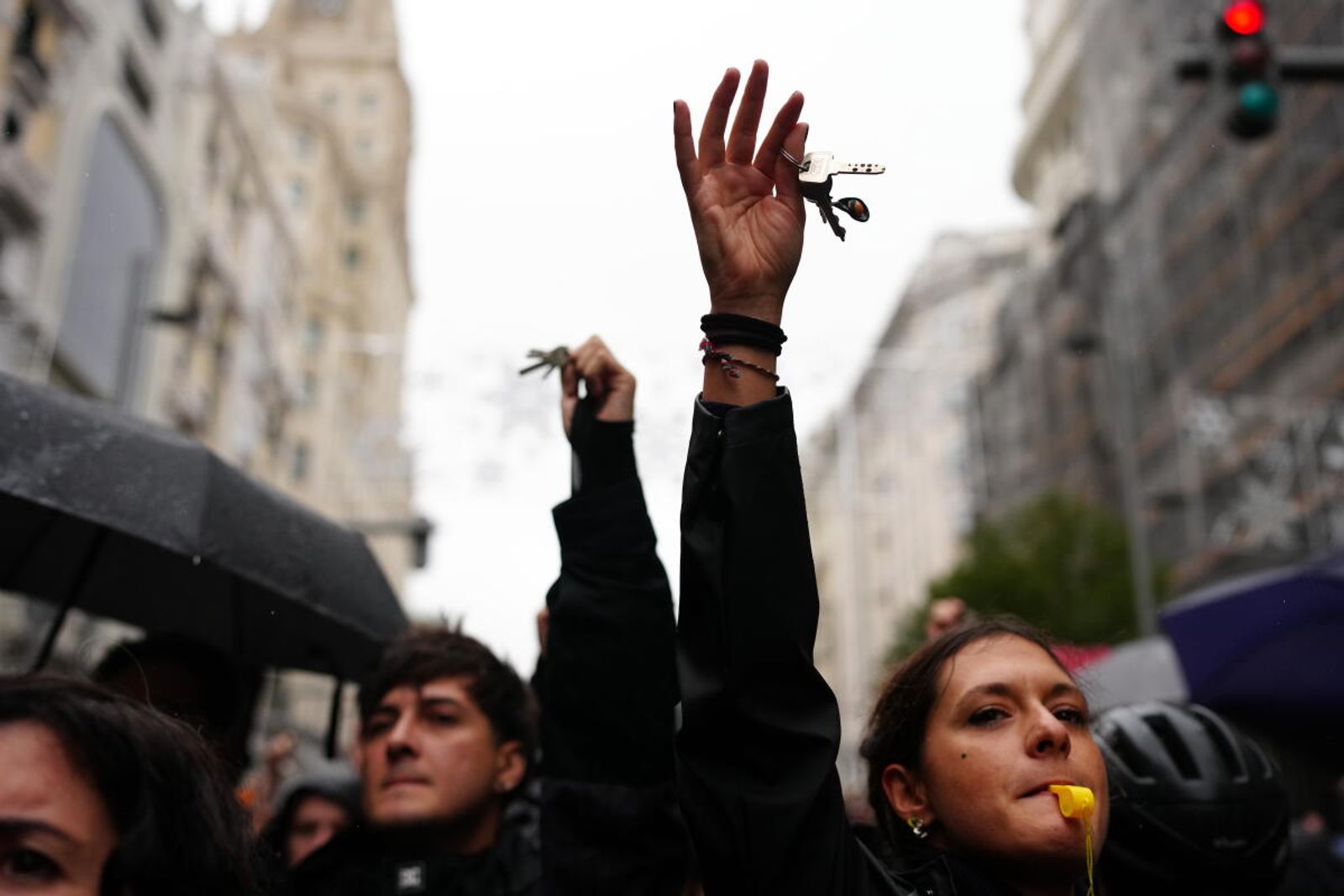
At the end of October in Brussels, nineteen-year-old Maya Gourdel, caught on Reuters cameras, sits at a table making a placard with coloured pens. The sentence she writes is a familiar one:
“If we burn, you burn with us!”
It is a line from Suzanne Collins’s The Hunger Games series, from its third book, Mockingjay. Gourdel, a Belgian student, is protesting for better conditions in schools. She says the cameras only turned to them once rubbish began to be set alight in the street; what she really wants is for the media to focus not on the violence but on their demands.
At first glance the words of a fictional heroine and the demand of a real student may seem very close, but a great deal changes on the way from Katniss’s world to Brussels. In the novel we know whom and what Katniss is standing up against, and what brought her to that point. In news footage, though, we usually find ourselves in the middle of events: crowds, police cordons, people running from water cannon, angry faces. These images do not always tell the story that brought the protesters onto the street.
In Europe’s autumn of 2026 these images multiplied. In the Belgian city of Liège, students protested against education costs and overcrowded classrooms from the start of October. In France, objections to school conditions widened to take in the cost of living and public services; on 17 October student organisations joined the unions and the Yellow Vests (gilets jaunes) in their cost-of-living call on the same marches, and in many cities the peaceful processions were accompanied by violence. The Yellow Vests were back on the streets on 24 and 31 October. The biggest day since 17 October came on 5 November: according to official sources 600,000 people filled the squares, according to the unions 1.6 million. In Madrid and Lisbon, housing became one of the main issues bringing people together in the squares.
It is not easy to gather these actions under a single heading. Throughout this piece we have used revolt as a broad heading that lets us think together about different forms of opposition, such as protest, strike and resistance. A student’s demand for education and a tenant’s fight for housing are not the same; a strike, a march and damage to public property are different acts too. Even so, complaints about school, work and home can meet in one question: how much say people can have in the decisions that shape their lives.
The sums done at home change once you are out on the street
In Émile Zola’s Germinal, before the great clash in a mining town in northern France, we are inside a home. What will go on the table, how many days will the wages last, how will the children be fed? For the Maheu family, work is not enough to guarantee a way out of poverty, to bring coffee, sugar and a piece of the meat they have long gone without; in short, not enough to get by. The decision to strike is no easy way out either: if people cannot make ends meet while working, how will they hold out when they are not?
Zola does not make the workers flawless in order to show they are in the right. Fear, anger, jealousy and solidarity live within the same neighbourhood. As the strike drags on, the cost of the words first spoken together differs from house to house. A week that one person can endure means hunger for someone else’s child.
“A man on his own might be strong and brave, but a community broken by hunger was powerless.”
We cannot imagine that today’s students live in the same conditions as Zola’s miners. But the question Germinal raises still holds today: when does a person begin to see a difficulty they have been trying to solve alone as a shared injustice? Someone who cannot pay the rent may first try cutting back on spending; a student who cannot find a seat in class may try arriving earlier. When they see that others are struggling with similar problems, they may realise these cannot be explained by personal failings. But this realisation alone does not create collective action; demands have to be shared, people have to reach one another, and the action has to be sustained.

Charles Tilly’s Social Movements looks at how this process works. It treats a social movement not as a single outburst of anger or a single march, but as a public campaign of demands sustained over time. It regards meetings, alliances, marches, slogans and strikes as parts of that campaign. Through them, activists show the public their worthiness, their unity, their numbers and their commitment. This is why the continuity of these efforts matters.
In France, ahead of the 5 November demonstrations, some workers were weighing up the lost wages that joining a weekday strike would mean, and whether the action would achieve anything. This hesitation is a reminder that sharing demands and taking part in action are not the same thing, and it brings the debate Germinal opens into the concrete conditions of today. When we are quick to accuse those who do not (or cannot) join a movement of indifference, we can make the cost of taking part invisible too.
Editor’s note: Rethinking rationality: as big goals recede, are we consoling ourselves with small pleasures? | Angst, Yasemin Kaya
Does silence mean consent?
So starting a movement’s story with the first march can make us miss what happened before it. James C. Scott, in Domination and the Arts of Resistance, examines the gap between what people say in front of the powerful and what they say among themselves. In relationships where open objection comes at a high price, discontent can live on in jokes, rumours, stories and indirect remarks. Obedience displayed in public does not prove that a person wholly accepts the order they live in. Scott’s concept of the “hidden transcript” tries to hear these conversations left outside visible politics.
The book steers us away from two easy readings. People staying silent for a long time may not mean they have no problems. Nor does their first open objection show that all their thoughts took shape that morning. Small injustices recounted to one another, a joke made behind the manager’s back, a glance that shows you are not alone. Scott counts none of these as the herald of a great uprising; he simply traces the forms dissent takes where it cannot be voiced openly. A student who keeps quiet in front of the school management but speaks up among friends is, in this sequence, doing something ordinary. Here Scott’s question splits in two: why does one person speak, and what is the other afraid of losing?
Are numbers enough?
After the everyday dissent Scott traces, Les Misérables takes us to the open struggle at the barricade. In the uprising that begins with General Lamarque’s funeral in June 1832, Enjolras and his friends fight for the republic while waiting for support from the rest of Paris. As dawn approaches, it becomes clear that the broad participation they hoped for is not coming. One of the men on the barricade says, “Citizens, let us protest by dying! Let us prove that even if the people abandon the republicans, the republicans do not abandon the people!” Hugo, who does not name him, calls him “the man who commanded the protest of corpses”.
Les Misérables shows that believing in a common cause may not be enough to move others to act. For those on the barricade the question is no longer only what they are against, but how they will behave when the support they expected does not come. Les Misérables shows us the loneliness of those waiting for support, and the distance between believing you are right and being able to move others. The moral force of a cause may not be the measure of its public support. Just as it is never clear how many of those who support from afar will take to the streets the next day. Just as, in Nasreddin Hoca’s tale of Timur’s Elephants, the folk sage turns round to find no one left behind him.
Zeynep Tüfekçi measures the same distance in the digital age. In her book Twitter and Tear Gas: The Power and Fragility of Networked Protest, not yet translated into Turkish, she asks why movements from Gezi (the 2013 Istanbul park protests) to the Arab Spring and Occupy first grew rapidly but in the end failed to last. In her view, online networks make it easier to bring people together, but the skills of deciding together, resolving disagreements and changing course do not build up at the same speed. Today it is possible to find someone in another city facing a similar hardship much more quickly. But the gap between sharing a slogan and shouldering the weight of a movement remains; real social change is built not by “keyboard activism” that never leaves its comfort zone, but by lasting ties patiently woven on the ground.
Staying in the city is a demand too
One of the demands bringing many people onto the streets today is to be able to stay in their home, in their city. Access to adequate and secure housing is recognised as a basic right bound up with human dignity. In Madrid, 87-year-old Maricarmen Abascal was evicted on a stretcher on 23 September from the home she had lived in since 1956. Abascal, who became one of the symbols of Spain’s housing rights protests, died on 7 October in the hospital where she had been admitted. On 11 November Spain had its first general strike in fourteen years, led by the Tenants’ Union. In Berlin, too, rents and the housing shortage were the most talked-about issue of the state election on 20 September.
Editor’s note: The politics of housing: why are rents so expensive? | Zappa Zamanlar
Not being able to pay the rent is not the only reason protests fill the squares. It is that the neighbourhoods where you could afford the rent lie outside the surroundings you are used to. Having to move away from your friends, your commute getting longer, the struggle to get by making you postpone plans to start a family, even having to move to another city. In the words of Özge Akkaya’s article, a “class farewell”.
Homes turning into instruments of profit and investment, neighbourhoods being demolished and rebuilt, or the way squares are used, directly affect the daily lives of the people who live there. That is why having a say in what this shared life will look like matters. Yet projects such as Sulukule and Tarlabaşı in Istanbul drove residents from their homes without giving them any say in how the place they lived in would change, or for whose benefit.
David Harvey, in Rebel Cities, discussing Henri Lefebvre’s idea of the “right to the city”, stresses that the issue is not merely making use of what the city offers, and asks the really critical question:
Who decides how the city changes?
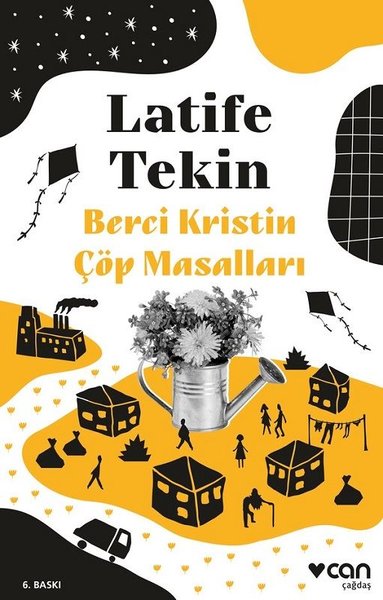
Latife Tekin’s Berci Kristin Çöp Masalları (Berji Kristin: Tales from the Garbage Hills) moves this debate to a rubbish hill. One winter night, eight shanty houses go up on the hill where the city’s rubbish is dumped, just beyond the heaps of refuse, below the pharmaceutical and light bulb factories. People rebuild the houses knocked down by the wind and the demolition crews with whatever materials they have left, again (and again). They name the hill “Savaştepe” (Battle Hill). A month later two men in official dress take the sign down and put up a blue tin plate reading “Çiçektepe” (Flower Hill). Warm blue water, waste from the pharmaceutical factory, flows into the neighbourhood. The faces of those who wash in it turn deep purple, their skin peels, their laundry takes on a blue tinge. Still the residents will not give up the water. When the pharmaceutical factory’s workers down tools, the neighbourhood loses the water. The strikers hand out leaflets in the neighbourhood and ask for support.
“The song dated from the first strike on Çöp Yolu (Garbage Road). It used to begin, ‘Çöp Yolu has a rose from the white tent, it has a rose but a rather brazen wind.’ It was composed by the women battery workers. After the battery strike, the thread workers who hung a strike banner on their gate let the wind carry off the song’s rose as they danced the halay (a folk circle dance) on Çöp Yolu.”
On Çöp Yolu, the strike song carries the resistance at one factory to other workers. In Ursula K. Le Guin’s The Dispossessed, how solidarity might work is debated this time through a utopian world.
Does equality come when property goes?
A group of people who rejected the unequal order on Urras found an anarchist society without private property on the arid moon Anarres. Shevek, a physicist, faces pressure to conform to the majority in this society too. Even with the state and private property abolished, social habits can leave those who think differently isolated. The novel’s subtitle, “An Ambiguous Utopia”, points to this contradiction. At a meeting he attends on Anarres, Shevek objects to the pressure on the individual to conform, arguing that
if we all agree, if we all work together, we are no more than a machine. If an individual cannot work in solidarity, it is his duty to work alone: his duty and his right. We have been denying people that right, saying more and more often that one must work with others and accept the rule of the majority. But any rule, whatever its form, is tyranny. The duty of the individual is to accept no rule, to be the initiator of his own acts, to be responsible. Only if he does so will the society live, and change, and adapt, and survive.
The limits of a just objection
A demand being just does not automatically make everything done in its name just. Take, for example, the burning of the historic town hall in the French city of Limoges by protesters.
Albert Camus’s The Rebel opens like this:
“What is a rebel? A man who says no, but whose refusal does not imply a renunciation. He is also a man who says yes, from the moment he makes his first gesture of rebellion. A slave who has taken orders all his life suddenly decides that he cannot obey some new command. What does he mean by saying ‘no’?”
The “no” of the slave in Camus’s example goes beyond refusing an order: the slave sets a limit to what is done to him and defends his right as a human being. He also accepts that this right does not belong to him alone. Camus’s critique of violence rests on this idea of a shared right. A struggle begun in the name of human dignity contradicts its own claim if it treats people today as expendable for the sake of an order to be built in the future. Camus does not ask us to give up objecting, but asks that revolt not trample with its own actions the value it defends.

Charles Dickens’s A Tale of Two Cities asks this question between the Paris and London of the years before and during the revolution. The cruelty of the aristocrats towards the people is the backdrop to the anger that builds. But as old injustices are called to account, justice turning into revenge also moves to the centre of the novel. While showing the suffering of the oppressed, Dickens does not ignore the new victims of revenge.
Who is on the same side
When we describe a demonstration we say “students”, “workers”, “the people”. These labels may be necessary, but they can easily cover over the differences within the crowd. Those who gather under the same demand may differ in what future they want, how much risk they can take and whom they will trust. A sense of unity sometimes softens these differences and sometimes makes them harder to voice.
George Orwell, in Homage to Catalonia, describes what he went through fighting Franco in the Spanish Civil War in the ranks of the POUM militia (a Marxist workers’ party). Besides what he saw at the front, he also writes about the political conflicts within the Republican camp and the crackdown on the POUM in Barcelona in 1937. The egalitarian atmosphere that first moved him gradually gives way to suspicion, propaganda and infighting.
Joining a movement does not mean endorsing everything within it. In a place where the labels “provocateur”, “hero” and “traitor” are handed out easily, Orwell looks at the fight behind the label.
After the squares empty
The news value of demonstrations usually fades along with the crowd. What people have lived through does not end as quickly. Being detained, being injured, being kept away from school or work shapes the rest of a person’s life. As much as a right won, what is lost along the way also becomes part of the movement. To see this we need to look beyond the days when events took place.

In May 1980, in the South Korean city of Gwangju, people rise up against the new military regime that seized power in a coup. Soldiers open fire on the demonstrators. Nobel literature laureate Han Kang’s novel Human Acts tells of those days. In the book, fifteen-year-old Dong-ho goes to the place where the dead are gathered to find a friend who was shot. He does not find his friend but stays on to help the volunteers. He covers the bodies laid out in the sports hall with white sheets and lights candles at their heads. He shows the dead to those searching for their loved ones. Later in the novel Dong-ho is killed too.
In her book Han Kang describes in detail what those who were arrested went through. A former detainee tells a researcher who interviews him years later about torture in which a ballpoint pen was jammed between his fingers. Eun-sook, who works at a publishing house, is slapped seven times on her right cheek during interrogation. On each of the following seven days she tries to forget one slap. At the same time she is working on a censored play script. The actors mouth the banned words on stage without making a sound. Even years after the uprising was crushed, those who try to tell what happened face repression.
Han Kang’s family left Gwangju in January 1980, about four months before the uprising. The writer was nine at the time. At twelve she finds a book of Gwangju photographs lying face down on a shelf at home. While the news was being suppressed, the book had been secretly printed and circulated by survivors and the families of the dead. Leafing through the pages hidden from the adults, she sees photographs of those who were killed. In another photograph, people are queuing outside the university hospital to give blood. In her Nobel lecture of 7 December 2024, Han Kang recounts that she asked the same question in front of both photographs: “Can humans do this to one another?” In the same lecture she also explains how the name Gwangju changed for her as she wrote the novel:
“When a time and place where human brutality and human dignity reach their extremes at the same moment is called Gwangju, the name ceases to be the proper noun of a single city and becomes a common noun. Transcending time and space, it confronts us again and again, always in the present tense.”
When people voice their objections, they draw on what they have read, listened to and watched. During the Gezi Park protests in 2013, some said “We are Turgut Uyar’s soldiers”, invoking the Turkish poet, or carried placards reading “We are Turgut Uyar’s lines of verse”. Since 2022 a Persian adaptation of the song Bella Ciao (Çav Bella) has accompanied the struggle of women in Iran. In Indonesia in 2025, young people raised the straw-hat pirate flag of the famous anime series One Piece at protests against the government. The three-finger salute from The Hunger Games travelled to protests in Thailand and Myanmar. And in Brussels, Maya Gourdel voices her objection in Katniss’s words.
In telling the reasons for revolt, literature also makes us question the actions of those who object, and helps us understand the reasons of those who hold back. In the Katniss line Gourdel carries on her placard, burning is a threat aimed at the other side, whereas in Nâzım Hikmet’s poem Kerem Gibi (Like Kerem) it is a call to share the responsibility of dispelling the darkness:
“If I don’t burn
if you don’t burn
if we don’t burn,
how
will
the dark--ness
turn to bright--ness..”
Note: The principles of liberty and equality championed in Europe were not applied in the same measure in its colonies in the past. We will look more closely at the traces of colonialism in literature in our next piece.