Istanbul from 6 to 6 | Tanrı Misafiri on Istanbul’s pop-up food scene
Tanrı Misafiri brought the pop-up wave to Istanbul, has brought international names to the city through its guest chef programmes, and turns six this summer. In their kitchen in Hacımimi, we sit down with Cem Balduk, Müge Büyüktalaş and Müge Tüzer to put both pop-up culture and Tanrı Misafiri’s direction on the table.
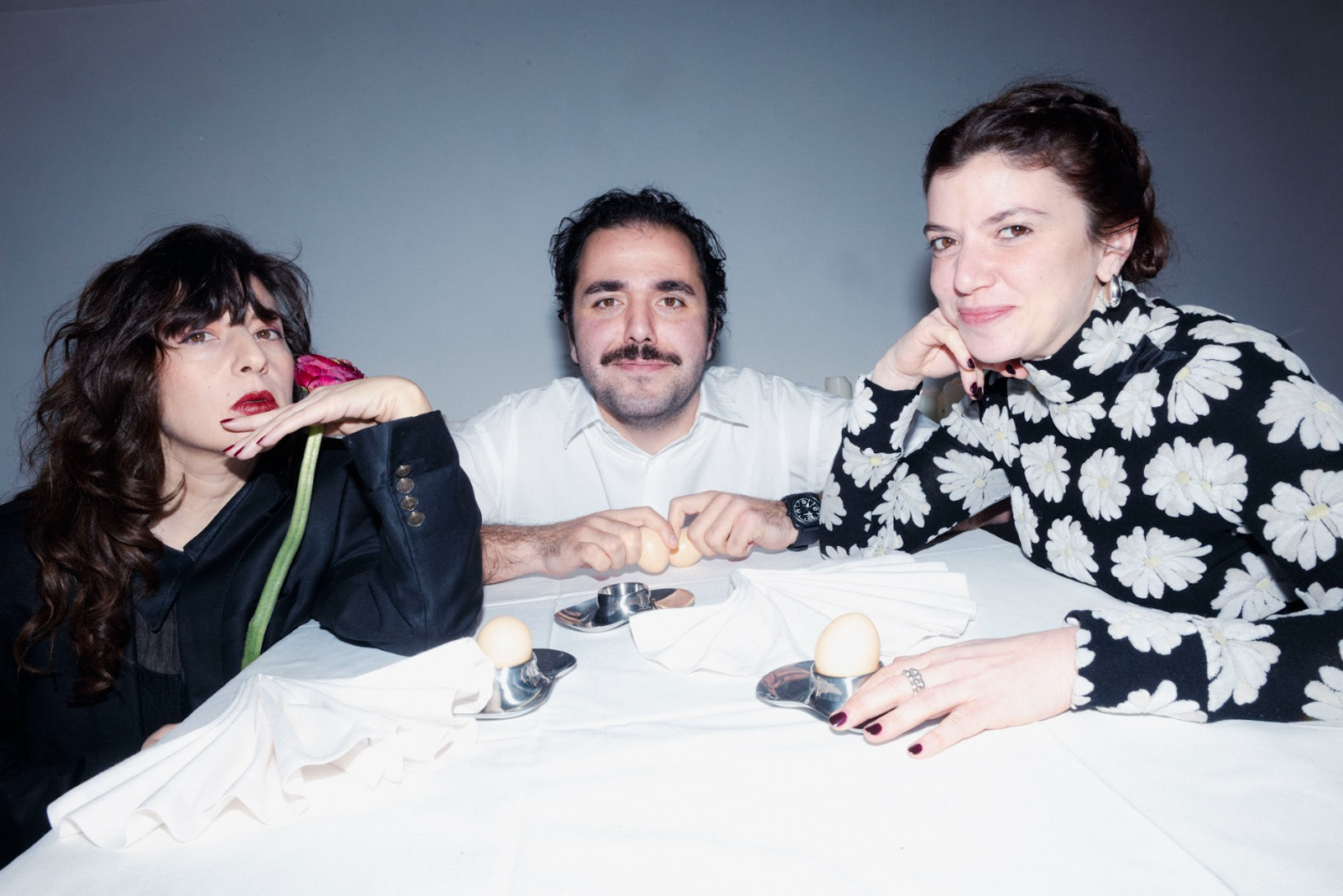
Photographs: Emirkan Cörüt
Summer 2020. The city is hushed. Or rather, voices have been turned down; in places hope has run out, in places there is resistance. For some sectors and some people in particular, these are harder days than ever. One of them is Müge (Tüzer).
Unable to move to Berlin to work in the music industry during the pandemic, Müge stays in Istanbul and rents a friend’s flat in Beyoğlu. Most of the people in the building are friends too. With work on hold, she starts hosting friends for dinner on the building’s terrace as a way to breathe in those days.
Then the table grows. A friend calls the guests at these dinners tanrı misafiri (literally “God’s guests”, the Turkish phrase for unexpected visitors), another friend designs a logo, yet another friend (Müge Büyüktalaş) joins in, and so Tanrı Misafiri is founded, on that rooftop in Hacımimi. Word spreads first among friends, then on social media, and then the harsh conditions of the pandemic ease little by little. People need more than ever to socialise, to be together, to meet around a table and to experience something new. Everything falls into place.
Tanrı Misafiri begins hosting its pop-up dinners in different places. Over time, their answer to this need for togetherness takes on real meaning in a city like Istanbul, where there is little variety of venues and few experiential events of this kind. In summer they head south too, but Istanbul, and Beyoğlu in particular, becomes home.
Cem (Balduk) joins them as a professional chef, and they put down roots in another way. While settling into Beyoğlu, they host chefs from cities around the world, travel as guests to cook in other cities and collaborate with various brands. Tanrı Misafiri is now becoming a multidisciplinary gastro project.
Meanwhile, pop-up dinners, event series and all kinds of gastro projects are on the rise around the world too. Factors such as customers seeking experiences more than venues, efforts to repair the damage done by the pandemic and the need to dive in without thinking about tomorrow in an uncertain climate clear the way for pop-ups and the collaborations that grow around them. At the same time, by giving young chefs a setting in which to cook and serve their own food without opening a restaurant, these projects work like a laboratory for the search for freedom and originality.
In a sense, the food and drink industry supports this unconventional, not especially conservative venture. Economic uncertainty, sustainability and the difficulty of growing aside, the sector feeds on these free projects, code-named pop-ups, which for a while at least cannot be defined in the traditional sense, because they open up an experimental space, a new mode of communication and interaction, not only for those in the kitchen but for everyone involved.
There are more and more models like We Are Ona , whose pop-up dinners, staged alongside international arts and culture events, create an experience specific to a time and place while bringing together, around a table, a community with shared tastes and interests.
At the same time, projects that work like gastro design and experience agencies, turning the table into a performative means of communication through collaborations with different venues and brands, are spreading, helped along by Instagram. Elsewhere, many pop-up gastro projects have opened permanent venues, bringing a different perspective to the sector with their adaptability and experience-led approach. Others keep experimenting without fitting any traditional definition.
As things stand, it hardly seems possible to fit Tanrı Misafiri into a traditional framework either. That is one of the reasons we wanted to put Istanbul’s unconventional food and drink scene, within the city’s night economy, on the table with them.
- In their words, “It’s not a restaurant, but it’s not a catering company either. Nor is it an art collective or an events agency. It’s an entirely different organism that carries something of all of these but doesn’t fully fit any of them.” That is Tanrı Misafiri.
The international names their guest chef programmes have brought to Istanbul’s food and drink scene, the wave of pop-up gastro projects they brought to the city, Istanbul’s particular conditions and the new movements rising against conservative food around the world… Where all of this meets a growing curiosity about “tasting” and designing, we join Tanrı Misafiri’s Müge, Müge and Cem in their kitchen in Hacımimi to talk about pop-up gastro projects and where Tanrı Misafiri is heading.

What were you doing before Tanrı Misafiri? How has working in those fields shaped Tanrı Misafiri?
Müge Tüzer: I was a music director and Müge was a film producer. The people we both knew from our previous jobs, and our wider circle, played a big part in shaping the project. Tanrı Misafiri was supported by exactly the right people, at exactly the right time, and very generously. The knack of “making it happen, whatever it takes” is also something we developed in our old jobs. Film production and festival production are both built on exactly that: “do whatever you have to, just make it happen”.
Müge Büyüktalaş: The table is a very powerful space for storytelling. Think of it as a blank canvas. With every dish, object and character added to it, the table becomes a different story each time. At the same time, our collective memory holds many images and sounds of the table that come from films. Cinema is often a good starting point for the feelings I try to bring visually to the tables we set. And of course I add my own memories too.
From Hacımimi to Bodrum, and on to Tomtom: Tanrı Misafiri 1.0
During the pandemic you started holding dinners on the terrace of the building in Hacımimi where Tanrı Misafiri now has its kitchen. Which events do you see as turning points for Tanrı Misafiri on the way to where it is today?
MT: Every event and every venue is a turning point, but Arte Heykel Bahçesi, a sculpture garden, is the most important place in this story. It became a home for us again after our terrace in Hacımimi, and then there are the good memories, the worries, the hopes and the fears we lived through in that garden… It was like a summer house holding so many memories from my childhood. We even hosted the wedding of our very close friends Furkan Temir and Öykü Baştaş in that garden. Lovely Arte!
MB: We both have a functional impulsiveness that kicks in once the necessary infrastructure and standards are in place. So I would say our turning points are not measured in scale or numbers, as might first come to mind, but have a more emotional meaning.
At the same time, you can only grow as you get stronger as a team. In that sense, moving to Arte and Cem joining us as Tanrı Misafiri’s chef was an important turning point. With his vision for gastronomy we dreamt up new projects and brought them to new people. Another important moment was becoming able to offer a more comprehensive service and evolving from a pop-up dinner project into a gastronomy agency.
Cem Balduk: In July 2021 we cooked a dinner at the Bodrum Kaplankaya pop-up of We Are Ona, the Paris-based pop-up gastronomy project. I’m not sure about Tanrı Misafiri, but for me it is probably one of the most important turning points. If I remember rightly, it was the first major event where I did everything on my own: the menu, the shopping and prep lists and so on. There were a lot of guests and their opinions mattered. For the first time I had an experience that I later guessed was a panic attack. I was really scared. Luckily most of the people working in the kitchen were our friends, everyone helped and we made that dinner. Since that day, things have always been easier for me.
If I answer for Tanrı Misafiri, I would say the event with Anim. The buffet and food installation we built there shaped the work Tanrı Misafiri would go on to do and changed its direction.

The defining traits of dynamic gastro projects are that they put collaboration at their centre and that they can adapt. With that in mind, how do you decide on Tanrı Misafiri’s collaborations and new event series?
MB: For the first two years we focused on our own pop-up dinners, but over time the dinners we designed specifically for brands came to the fore. There are both logistical and economic reasons for this. Pop-up dining trends around the world have moved in this direction too. Independent events are hard to sustain because there are many standards that have to be met. With brands, we first develop ideas based on the brief we receive.
Collaboration dinners also function as a form of communication, so many details are shaped by that. On the other hand, there is also a way of working we offer our collaborators, where we come up with the idea first and then make it happen. The guest chef programme, through which we host chefs from abroad, is the best known of these.
From zero to one: the rise of pop-ups in Istanbul and a period of pause
Although they reached Istanbul a little late, pop-up dinner series and gastro projects have gathered pace around the world, especially since the pandemic, thanks to the freedom and room for discovery they give chefs, their lower economic risk compared with a restaurant and the way they answer consumers’ need for experiences. On the other hand, the city has its own dynamics. Before you started, what disadvantages and advantages did you see in Istanbul?
MB: Since we entered this sector in 2020, I wouldn’t want to analyse what came before, but as someone who follows the city’s lively social life closely, I think Istanbul has a world that adapts quickly, is very inclusive and keeps changing. In that kind of environment, pop-up dinner series were quickly embraced. After Tanrı Misafiri, many new projects started up in the city. This trend will continue, because the table is a wonderful place to meet. That said, I should add that it is getting harder because of the ongoing economic crisis.
CB: When I think of pop-ups before the pandemic, Wondercats is the first thing that comes to mind. Of course, Emirhan (Paralı) and his team put on events with much bigger budgets, built around amazing themes and aimed at offering a truly extraordinary dining experience. Tanrı Misafiri, on the other hand, was more about coming together around food. In a setting that wasn’t a restaurant, with limited means, we tried to create spaces that felt like a relaxed yet sophisticated restaurant experience. When Müge (Tüzer) held the first dinner on the rooftop, some of my chef friends and I were really impressed that someone who wasn’t a professional cook could pull off an event like that. We knew similar things were spreading around the world, but it was still inspiring. I don’t think there was any other venture like it in Istanbul at the time. The pandemic had set everything up for an idea like this to succeed.

Istanbul’s biggest disadvantage is the problem of infrastructure and venues. It’s an enormous city, but forget an extraordinary venue, which is hard enough to find; even finding an empty space with proper infrastructure for cooking is not easy. Even when you do find such places, the daily rents are very high. That is what challenged us most. On the other hand, the city has a fantastic young population, but it can’t offer the variety of venues and events to satisfy them gastro-culturally or to meet their need to come together. So structures like ours, which work without a venue and around events, probably fill those gaps in the city more easily.
Since 2020, how far have Istanbul’s gastro projects that aren’t tied to a single venue come, especially given the changing needs and trends of the night economy?
MB: With the economic crisis, you can see a drop in the number of events. When you consider the tax on alcohol, the property crisis and the value the Turkish lira has lost, there is really nothing more to say. At the same time, the sector in Istanbul may have become a more active player internationally now that the Michelin Guide and other international guides are active here, but that can only pave the way for amorphous growth. In this situation, survival will become harder by the day for alternative projects.
CB: As for how far it has come, we can safely say it has gone from zero to one. If conditions in the country had allowed, it would probably have gone from one to ten, but that didn’t happen. What would that “ten” have looked like? I suppose that instead of the players in this game today, who number fewer than the fingers on two hands, people from outside would have joined in too. Foreign chefs and restaurants would come and go often, and the food and drink scene would be far more varied. We’re not there today, but I still think pop-ups are worthwhile, that regardless of what they offer, and even if they change form, their numbers will grow, and that this will help increase the city’s gastronomic appeal.

What changes have you seen in pop-up gastronomy projects in other big cities in recent years? How do food and drink trends show up in pop-up projects?
MB: Pop-up dining is not yet very scalable, but we can mention a few different examples. On one side there are groups, mostly focused on Europe, that work almost like NGOs, concentrating on the social and cultural values of food and examining issues such as access to food. You can apply to them with your project and get a residency. At the other end there are brands like Paris-based We Are Ona or Laila Gohar that create projects around fashion and design and stay true to the standards of luxury consumption and fine dining. In between you can find many projects started with different motivations. Some are product-led, others focus on design, and there are even those that treat food purely as artistic production.
Personally, I haven’t seen a single food and drink trend dominate. But it has to be said that on social media you can see visual worlds that aesthetically repeat one another. They all appear and vanish like short-lived trends.

What role can pop-up dinners, which offer an environment well suited to research and experimentation, play in developing the city’s food scene?
CB: When guests come to pop-up dinners like these, they usually set aside the expectations they carry with them in daily life. They are more open to trying new things, more curious and, most importantly, more tolerant of mistakes. On top of that, you can get feedback from guests that is more honest and immediate than you would ever get in a normal restaurant. So we can create settings where dishes are tested. For a project like ours, which doesn’t yet have a permanent venue but has becoming one among its ultimate goals, this is a tremendous opportunity.
How did you create a playground for yourselves in the kitchen along the way?
MT: To give an example, in 2025 we used the space that is now Tanrı Misafiri’s kitchen as an R&D space. Like some companies around the world that we love following and that do pioneering work in the sector, we used it to make high-quality, brand-specific products, to think more about our catering and productions, and to come up with better set designs. For Cem, it was a lab where he could work on fermentation with Sungur (Altınöz), one of the partners of TamTam, another Istanbul-based gastronomy project. Our goal is still to put our name to higher-end projects where design comes first.

What is Tanrı Misafiri’s relationship with Beyoğlu, where it served its first dinners six years ago and where it has now set up its kitchen?
MT: Tanrı Misafiri is a true child of Beyoğlu. It may go off travelling everywhere, but it always finds its way back to Beyoğlu. It’s a mischievous child that carries the romantic, international and spontaneous spirit of this area. Most of the pop-ups we’ve done over the years were in Beyoğlu, and giving people a reason to come here makes us very happy.
MB: I have lived in Beyoğlu for many years. I don’t know if there is anywhere else in the world that has changed so much and so visibly. With every change it quietly holds on to little things left over from before. In that sense I think it has built up a remarkable store of layers. I feel we are on the threshold of a new transformation.