


Good morning from mid-November, a fresh day in Pera, Istanbul.
Half of our team has returned to Istanbul, and the other half is still at COP, covering the conference and holding interviews with valuable leaders from the country and all around the world. I have a busy week ahead and I'm feeling too many emotions at the same time. We are setting up a new office in Pera, Istanbul, at a very special historic location we have been dreaming about for 2.5 years now. This week, finally, it is happening.
When I was doing a fellowship at the Stanford d.school, back when we talked a lot about design thinking, lean startups, human-centered design and so forth, I came across a beautiful book about office design by Scott Doorley and Scott Witthoft called Make Space. I remember how this quote made me think not only about offices but about all the physical places that surround us: "Space is the body language of an organization."
Since then, we have set up an office in Galata, Istanbul, one of the most touristic neighborhoods of the town. Our office evolved from a small gathering place to a working setup, then to an event place, and eventually a studio. We have so many memories here with so many different people. We will have more words about our old and new offices in the upcoming days.
Outside Antalya, last week was a busy one. Türkiye is still struggling with the fund crisis, both internally and externally, and I don't think it will stop in the upcoming months either. The Jensen Huang situation opened up tens of ethical and political discussions, all at once, condensed into a single week.
And I have just seen Nathan Fielder's documentary You Can See Everything. It is a phenomenal work, and it has written its name into the history of documentary making. But towards the end, I wondered if there was a deliberate sensationalization of a crime that was very clear from the very beginning of the investigation. The goal? I believe it was creating a great documentary that pushes the boundaries. Where does art stand in these situations? Is pushing the edges of the facts to craft one of the greatest documentaries ever made justifiable for an artist? We have seen so many examples of this in the depths of the history of art. Anyway, it is not the usual work you come across in theaters, and it is truly creative, original and authentic. Three qualities we have been missing more and more every day, and striving to have more of in our work and our lives, in the age of AI.
Have a nice week.
Stay tuned for our updates,
Orhun Canca
Elsewhere in this edition:
🇪🇪 Estonia to close all Russian border crossings from 1 December
🇮🇷 Iran's Guards claim a mine sank a supertanker
🇨🇿 Czechs rally in Prague for public media
🎵 A soundtrack for today's read: Water No Get Enemy by Fela Kuti
 Aposto World
 is our English-language briefing on the news that matters around the world, written by the Aposto newsroom in Istanbul. Every Monday and Friday morning we go through the international press, region by region: the UK, Europe, the US, the Middle East, Africa, Asia-Pacific and the rest of the world, with a closing section on culture, science, technology and sport. Each story is told in a few clear lines with the context you need, and links to the original reporting so you can read further. One email, twice a week, and you are up to date.
Burnham says Brexit has not worked: Prime Minister Andy Burnham is due to tell a City of London audience that "the Brexit we were given has not worked", and to set out his conditions for a closer relationship with the EU ahead of Friday's UK-EU summit. He will say he is ready for a national debate on a longer-term accord with Europe.
- What happened? Hamish Falconer, the EU relations minister, said the UK would have a "voice in the room" but no vote on EU food rules under the deal, and would make no upfront payments. The deal is likely to include an exit clause, which reflects EU worries about the cost of rebuilding post-Brexit border checks if a later government reverses course.
- Why it matters: The government puts the food element at £5bn and the whole package, which also aligns emissions trading and adds a youth mobility scheme, at 0.4% of GDP. The Conservatives and Reform say they would undo it, and Labour backbenchers are restless over Europe too.
Bank of England's chief economist expects more rate rises: Huw Pill, the Bank of England's chief economist, told the Financial Times on Saturday that interest rates have "further to go", after the Bank's quarter-point rise to 4% earlier this month. The Guardian reports he said rates would probably need to rise again next month and early next year.
- Zoom out: The Bank's own forecasts show inflation reaching about 5% by the middle of next year, more than double its 2% target, despite the strong growth figures of last week.
- Looking ahead: The next rate decision is on 17 December, and a growing number of analysts expect a rise to 4.25%, which would push up mortgage and business borrowing costs before the expected jump in energy bills in January.
Milburn youth jobs review due Tuesday: Alan Milburn, the former Labour minister leading a review of youth unemployment, will publish his proposals on Tuesday, including a legal "opportunity guarantee" of a job, training or employment support for every young person. Those who refuse the help could lose their benefits.
- The backstory: Milburn says the government spends 25 times as much on benefits for young people as on getting them into work and wants that ratio cut to two to one; the state already spends £22bn a year on economically inactive young people, and almost one million are not in education, employment or training.
- What they're saying: Burnham has promised a "root-and-branch rethink", with intervention from childhood and more vocational training in schools, but declined to commit to the report in full. A statement to Parliament follows on Tuesday and draft laws early next year.
Labour MPs oppose Rosebank oilfield: Seventy-five Labour MPs have signed a private letter to Andy Burnham opposing the Rosebank oilfield off Shetland, and the number could reach 100 before it is delivered within the next fortnight. The government has yet to decide whether to grant fresh approval for Rosebank, the UK’s largest known untapped oil field.
Furthermore: Gas began flowing on Monday from the Jackdaw field, 150 miles east of Aberdeen, which ministers approved last month; its operator Adura, a Shell and Equinor joint venture, says at its peak, it will account for about 6% of UK gas production, or about 2% of total demand once imports are counted.
A step back: Both fields were approved under the previous Conservative government, then struck down by Scottish courts after a Supreme Court ruling that developers must account for the emissions from burning the fuel they produce.
EU states plan Rwanda return hub: Denmark, Austria, Germany, the Netherlands and Greece were expected to announce on Monday a scheme to send rejected asylum seekers to a return hub in Rwanda. The five are in the final stages of negotiations with Kigali, and the first pilot could become operational in mid-2027.
Why it matters: Euronews describes it as the first return hub for migrants in Rwanda run for EU states, a model that rights groups and lawyers say may clash with fundamental rights and EU law.
Zoom out: Spain's coastguard said on Sunday that nearly 2,200 migrants had reached the Canary Islands in two days, including a record 1,488 in a single day, days after Spain declared a migration emergency there.
Spain votes on 29 November: Spaniards vote on 29 November in the country's sixth general election in 11 years, and polls give the conservative People's Party (PP) about 130 of 350 seats, the Socialists about 110 and the far-right Vox about 63. A PP-Vox deal would clear the 176 seats needed for a majority and could bring the far right into government for the first time since the return to democracy after Franco's death.
- The backstory: Pedro Sánchez's campaign has been overshadowed by the high-speed rail crash that killed 69 people on 28 October, nine months after 46 died on the same line; the transport minister, Óscar Puente, resigned days later.
- Big picture: The PP and Vox already govern four regions together. Vox's leader, Santiago Abascal, campaigns on "national priority" for Spaniards in housing and benefits, which the PP says must stay within Spanish and European law.
- Furthermore: The parties to the Socialists' left, including the Broad Front led by the former Barcelona mayor Ada Colau and Podemos, are forecast to win about 13 seats between them, far short of what Sánchez would need for another coalition.
Estonia to close Russian border: Estonia plans to close its road border crossings with Russia from 1 December, the foreign minister, Margus Tsahkna, said on Sunday. The decision follows an attempted attack on the drone maker Threod Systems on Saturday that Estonian authorities say was ordered by Russia's GRU military intelligence service.
- What happened? Eight people were detained in connection with what Tallinn describes as an attempted arson attack on the company, which builds long-range attack and reconnaissance drones; no injuries or damage were reported after its security team responded.
- What they're saying: The prime minister, Kristen Michal, said the GRU had ordered the "sabotage attempt" and linked it to Estonia's support for Ukraine.
- Furthermore: Tallinn is also building a plan to run the state's digital services from the cloud abroad if data centres are destroyed or its territory is occupied, extending its existing data backup in Luxembourg.
Czechs rally for public media: More than 350,000 people rallied on Letná Plain in Prague on Sunday against the government's plan to scrap licence fees and fund Czech TV and Czech Radio from the state budget, according to the organisers, Million Moments for Democracy. Organisers said turnout exceeded a March protest of more than 200,000, which could make it the largest demonstration since the 1989 Velvet Revolution.
- Why it matters: Critics say state-budget funding would give ministers leverage over newsrooms, as happened in Hungary and Slovakia; the plan would also cut the broadcasters' budgets by about 15%.
- What they're saying: The prime minister, Andrej Babiš, called talk of "nationalisation" a deliberate lie and said the government would not interfere in editorial work. The fees add up to 205 koruna (£7) a month.
- A step back: The protests began in late October, when the bill's first reading was pushed through in the middle of the night. Babiš's ANO still polls about 30%.
Zelensky says US floated NATO-for-Donbas idea: US negotiators raised the idea of Ukraine withdrawing from the rest of the Donbas in exchange for NATO membership, Volodymyr Zelensky said in remarks released on Saturday, the first time the link had been made in the talks, he said. Washington has not confirmed it. Zelensky said he would put a package with security guarantees, no limits on Ukraine's army and reconstruction funds to a referendum.
- What they're saying: A US official told the BBC that "many ideas continue to be discussed", while the US envoy Jared Kushner urged confidentiality and said both sides had set out "maximalist positions" in Abu Dhabi.
- The backstory: Two days of US-brokered talks in Abu Dhabi ended on Wednesday without a breakthrough, though Zelensky said the sides agreed a prisoner exchange involving more than 1,000 people. Russia insists Ukraine must cede the parts of Donetsk and Luhansk it has not captured.
- Looking ahead: The European Commission is due to present member states on Wednesday with a €45bn loan for Ukraine, borrowed against the EU budget, to bridge Kyiv's funding gap next year.
Sparktour / Wikimedia Commons, CC BY-SA 4.0
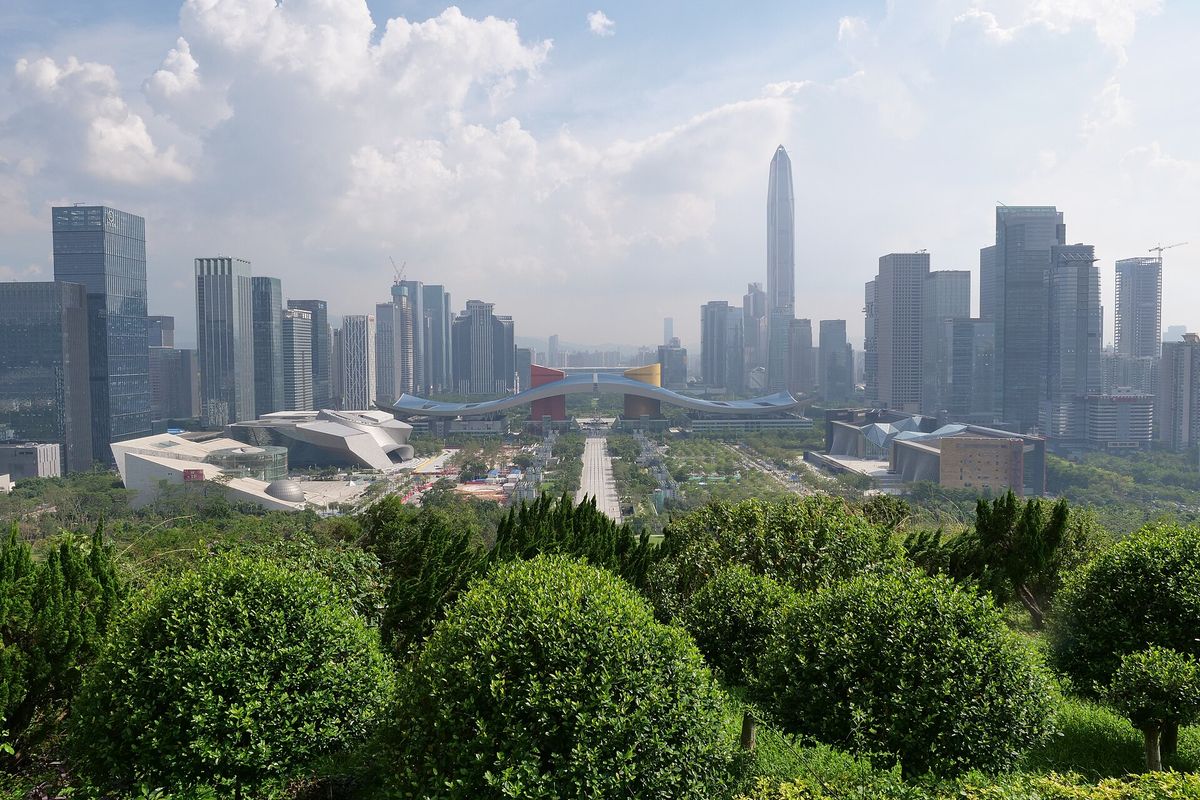
Trump, Xi and Putin to meet: Donald Trump, Xi Jinping and Vladimir Putin will meet together in Shenzhen on Thursday, on the sidelines of the Asia-Pacific Economic Cooperation (Apec) summit. It will be the first three-way meeting of the leaders of the US, China and Russia. The White House announced it on Friday, the Kremlin confirmed it on Saturday, and China's foreign ministry confirmed it on Monday without giving an agenda.
What they're saying: Olivia Wales, a White House spokeswoman, said Trump would discuss "the reduction of nuclear weapons in the world". The war against Iran is expected to come up; Russia's war in Ukraine is not.
Why it matters: A US-Russia nuclear arms control treaty expired in February, and The Pentagon projects that China could have more than 1,000 warheads by 2030. Senior US officials said they expected no agreement and called the talks a starting point.
Looking ahead: Trump attends the Asean summit in Manila on Tuesday, where he is expected to hold the first Quad meeting of his second term with India, Japan and Australia, then has a bilateral meeting and working lunch with Xi on Thursday before the trilateral.
Congress weighs chip export curbs: Lawmakers of both parties are pushing to tighten exports of AI chips to China after Jensen Huang resigned as Nvidia's chief executive last week over affairs, one with a woman US intelligence officials believe is a Chinese asset. House Speaker Mike Johnson said there was a "developing consensus in Congress" on limiting chip exports to China, and stalled bills such as the Remote Access Security Act, first introduced in the House in April 2024, are drawing renewed interest.
Behind the scenes: Experts on Chinese intelligence told The Atlantic that Alice Huang was probably not a trained operative; more likely, China's Ministry of State Security learned of the affair and then recruited her. Beijing calls the allegations baseless smears, and US officials have not presented their evidence.
Why it matters: Huang shaped Trump's view that keeping China dependent on American chips preserves US dominance, and sat at the head table at Trump's state dinner for Xi in September. He is not expected in Shenzhen this week, and US officials say he is not expected to raise the matter with Xi.
Looking ahead: Huang has been asked to testify to the Senate Banking Committee on 3 December, after a closed-door House interview requested for 1 December.
Nationwide US ground stop: The Federal Aviation Administration (FAA) halted nearly all departing flights across the US for almost five hours on Friday after a communications failure. Airlines cancelled nearly 10,000 flights that day, nearly 6,700 more on Saturday and about 2,000 on Sunday.
- What happened? Transportation Secretary Sean Duffy said the installation of at least one new router by the contractor L3Harris at a remote facility triggered the failure, which hit communications at 17 of 22 en route centres. He said it was not yet known whether the cause was installer error or a faulty router.
- What they're saying: Trump blamed the Biden administration and called on Congress to fund an upgrade of air traffic control. Duffy said on Sunday that operations would probably be fully normal by Monday, a day later than the FAA had promised.
PAHO panel finds measles endemic: An expert panel of the Pan American Health Organization (PAHO) concluded at a three-day meeting in Washington last week that the same measles strain has circulated in the US for more than 12 months, which means the country will lose the elimination status it has held since 2000. The formal declaration is expected early this week.
- Zoom out: More than 5,000 cases have been confirmed in 45 states this year, the worst year since 1991. Pennsylvania has reported seven deaths, New York one and Wisconsin two.
- The backstory: Health Secretary Robert F. Kennedy Jr. told a Senate committee in April that the epidemic began before he took office; it was spreading in West Texas by January 2025.
Iran resumes drone attacks on Bahrain: Iran's Revolutionary Guards said they launched six drones on Sunday at a US air defence radar at the Al-Rifaa helicopter base in Bahrain, their second attack on the kingdom in three days. Bahrain said its air defences intercepted the drones before they reached their targets. Sirens and shelter alerts sounded across the island for the first time since September.
- The backstory: Iran called the strikes retaliation for 'hostile US actions', after a series of recent US strikes on Iranian targets including Qeshm Island. Last week Donald Trump said Washington was no longer seeking a deal with Tehran. Esmaeil Baghaei, Iran's foreign ministry spokesman, said Iran was 'not waiting for anyone'.
- What they're saying: Bahrain's foreign ministry called the attacks 'heinous aggression' and held Iran fully responsible. Jordan, Egypt, Saudi Arabia and Qatar condemned them.
- Looking ahead: The USS Theodore Roosevelt has arrived in the region, the third US aircraft carrier there, according to reports. If all three stay, the US presence would be at its highest since April. Iran has warned it could strike first.
Iran says mine sank a supertanker: Iran's Revolutionary Guards said on Sunday that two oil tankers on an 'unauthorised route' in the southern Strait of Hormuz struck mines and that one, a supertanker carrying more than 2m barrels of crude, sank in the southern Gulf. The Guards did not name the vessels or their crews, and there has been no independent confirmation.
- Important note: The US military recently said it had cleared all mines from the main routes through the strait. Iran's navy also said that three tankers caught fire after hitting mines on Saturday, which Reuters could not verify, and that another struck a mine east of the strait late on Sunday.
- Zoom out: The claims follow two weeks of falling oil prices. Brent settled at $95.84 a barrel on Friday 13 November, having fallen earlier in the week to its lowest since late August. The International Energy Agency (IEA) said supply exceeded demand by almost 2m barrels a day in October, the first surplus since the war began.
Yemeni government forces leave Bab el-Mandeb: The Southern Armed Forces, the main force fighting for Yemen's internationally recognised government in the south, said on Sunday they were withdrawing from Dhubab airport and the Bab el-Mandeb area to defend Aden. Reuters called it the apparent end of a six-week Saudi-backed counteroffensive. Houthi-run media said the group had taken the evacuated territory.
- What happened? Government and military sources told AFP that the Houthis had seized two districts in Lahj province and were at the Al-Kharaz camp in Al-Madariba, 60km from Aden. Government forces have been building sandbag defences and digging tunnels around the city, the seat of the government since 2015.
- Why it matters: With Hormuz disrupted, Saudi Arabia has relied on the Red Sea for oil exports. The Houthis say they will keep targeting Saudi vessels, and now hold territory overlooking the Bab el-Mandeb.
- The backstory: Taiz, Yemen's third-biggest city, remains besieged. It hosts about half of the 300,000 people displaced by the latest fighting, according to Reuters. The Houthis released 600 prisoners, the International Committee of the Red Cross said on Sunday.
Eisenkot says Netanyahu must go: Gadi Eisenkot, the Yashar party leader tasked with forming Israel's next government, said on Sunday that Benjamin Netanyahu, the caretaker prime minister, could not remain in office 'for even one more minute'. He was responding to a Channel 12 investigation into alleged election interference by Netanyahu's office, and called for an inquiry.
- What happened? Channel 12 reported that Ido Norden, Netanyahu's chief of staff, complained to the police commissioner's office on the eve of the 27 October election about three United Arab List (Ra'am) activists, and pointed police to a source who had worked in the prime minister's office. About 14 officers raided their homes without warrants; the men were later released. The report also said David Zini, the Shin Bet chief, sought to wiretap five Arab members of the Knesset on election day, which the attorney general, Gali Baharav-Miara, refused.
- What they're saying: Likud called Eisenkot's statement 'outrageous incitement'. Some allegations in the report remain unresolved.
- Big picture: Eisenkot has 28 days from 8 November, with a possible 14-day extension. His bloc holds 48 of 120 seats, Netanyahu's 53 and Arab parties 19. Representatives of the two men had met hours earlier to discuss a unity government; Israel Hayom reported Netanyahu's associates would accept one without Itamar Ben-Gvir's party, which Likud denied.
Türkiye and Qatar sign defence pact: President Recep Tayyip Erdoğan and Qatar's emir, Sheikh Tamim bin Hamad Al Thani, signed a mutual defence agreement in Istanbul on Friday, committing the two countries to a 'unified position' against an external armed attack on either. It also covers consultation on threats, joint exercises, defence industry projects and training exchanges.
- Zoom out: It is Ankara's second such pact this year. Türkiye, Pakistan and Saudi Arabia signed a mutual-aid pact in August, which the Turkish parliament ratified last week, and Qatar, Indonesia, Pakistan and Türkiye signed the 'Badr' defence memorandum in Doha in October.
- Big picture: Gulf states are turning to Ankara for deterrence after the Iran war, in a shift Haaretz says is forcing Israel to rethink what it can offer them. Erdoğan said the two would work together 'to prevent a renewed outbreak of war in the Gulf region'.
Ebola outbreak passes six months: The Ebola outbreak in the Democratic Republic of Congo, declared in May, has passed 11,000 reported cases and 5,400 deaths, the World Health Organization (WHO) said in a release on Sunday. Between 400 and 500 new cases are still reported each week, and the virus has spread to 67 health zones in eight provinces.
- Why it matters: Children account for more than a quarter of confirmed cases and a third of deaths, and seven in ten children under five with confirmed Ebola have died. There is no approved vaccine for the Bundibugyo strain behind the outbreak.
- Behind the scenes: An armed attack in Cantine-Aloya killed 66 civilians, including three health workers, and left more than 1,000 contacts lost to follow-up; the WHO counts over 80 attacks on health care since the outbreak began. The New York Times reports that the Islamic State now threatens the response around Biakato, a rainforest town that at one point accounted for up to a quarter of new cases nationally.
- Zoom out: Recent imported cases have reached Kenya and Nigeria. Nigeria's index patient, evacuated to Switzerland, has recovered, and all 62 contacts finished 21 days of monitoring without a secondary infection, the Nigeria Centre for Disease Control said on 13 November.
Sudan's army takes Al-Khuwai: Sudan's army captured Al-Khuwai, one of West Kordofan's main cities, on Friday after breaking through the lines of the paramilitary Rapid Support Forces (RSF), the Sudan Tribune reported. Its next objective is En Nahud, the province's second city and the site of gold mines, on the highway towards Darfur.
Why it matters: Gold has funded the RSF's war, with billions of dollars' worth smuggled to the United Arab Emirates, according to The New Arab. The advance follows the breaking of the RSF's partial siege of El Obeid and defections of formerly aligned tribes to the army.
Big picture: Drones are now the leading cause of documented conflict-related civilian deaths in Sudan this year. The UN counted at least 306 people killed by drones in the first three weeks of October alone, and a double strike on a transportation truck in Al-Dibab on 18 October killed at least 139.
Looking ahead: The army's chief of staff, Yasser al-Atta, has claimed the military will win the war by December, a forecast Sudanese analysts treat with scepticism.
South Sudan delays first national election: South Sudan's National Elections Commission said on Saturday that presidential and legislative elections due on 22 December will be held on 11 February instead. The country has never held a national election since independence in 2011; the information minister said the delay gives more time to register and educate voters.
- The backstory: The vote was meant to underwrite the 2018 peace deal, which has unravelled since the opposition leader Riek Machar was placed under house arrest in March 2025 and charged with treason. With Machar sidelined, President Salva Kiir faces no credible challenger.
- What they're saying: The International Crisis Group told the UN Security Council last week that conditions for credible polls are not in place and that rushed elections could open the door to a return to sustained large-scale violence.
- Important note: Civil servants have not been paid in more than a year, and more than 8 million of roughly 12 million people need food assistance, according to the Famine Early Warning Systems Network.
Uganda's army chief threatens vice-president: Gen Muhoozi Kainerugaba, Uganda's army chief and the son of President Yoweri Museveni, threatened Vice-President Jessica Alupo with dismissal and possible arrest last week and suggested he should take her post. The move adds to open manoeuvring over who succeeds Museveni after four decades in power.
- Behind the scenes: At least a dozen generals and senior officers have been arrested since April 2025, according to the Daily Monitor, among them former deputy army chief Lt Gen Peter Elwelu, detained on 2 November. Kainerugaba announced on X that Elwelu had been demoted to private; the army says it recovered 15 guns linked to him, and his family rejects the allegations.
- What they're saying: Five party sources told AFP that a meeting of the ruling National Resistance Movement's leadership on 10 November abandoned a vote on positioning Kainerugaba as successor. The party's secretary general, Richard Todwong Awany, called reports that the proposal had been rejected "completely false".
Asean summit opens in Manila: The Association of Southeast Asian Nations (Asean) summit opened in Manila over the weekend, and the bloc and China again failed to conclude a code of conduct for the South China Sea. Theresa Lazaro, the Philippine foreign minister, said on Sunday that about 80% of a draft was tentatively agreed but that key issues, including whether the code would be legally binding, were unresolved. Manila had promised a deal this year; Lazaro now hopes it can be concluded under Singapore, which chairs the bloc next year.
- Looking ahead: Donald Trump arrives on Tuesday and is expected to hold the first meeting of his second term with his Quad partners, India, Japan and Australia. Nearly 20,000 police are deployed for the summit, where an anti-Trump march is planned, much of it aimed at the US Pax Silica supply-chain programme, whose 1,620-hectare AI manufacturing hub north of Manila Indigenous Aeta families say will force them off ancestral land; the government says the effect will be minimal.
- Furthermore: China's upgraded free-trade pact with Asean, the 3.0 protocol, is to take effect on 1 December. Australia and the Philippines signed a new Defence Cooperation Agreement, and the US and nine partners signed an accord to keep China out of AI supply chains.
- Important note: Asean extended its ban on Myanmar's leader, Min Aung Hlaing, attending its summits, saying Myanmar had failed to comply with the bloc's 2021 peace plan.
ICJ to rule on Rohingya genocide: The International Court of Justice (ICJ) in The Hague will deliver its judgment on Thursday morning on whether Myanmar committed genocide against its Rohingya minority, in the case brought by the Gambia under the 1948 genocide convention. The court has never found a state responsible for genocide.
- Why it matters: In two Balkan cases the court stopped short of that finding; in the Bosnian case it held Serbia responsible only for failing to prevent and punish the genocide at Srebrenica. How it treats proof of intent will bear on the separate genocide case against Israel.
- The backstory: Judges have weighed the case for seven years. Myanmar denies genocide and says its 2017 'clearance operations', which drove hundreds of thousands of Rohingya into Bangladesh, targeted insurgents after attacks by a Rohingya militant group.
- What they're saying: Antonia Mulvey of Legal Action Worldwide, which represents hundreds of survivors, said sexual violence is a critical part of showing intent to destroy the group, and that the court's handling of it will be a key part of the judgment.
Indonesia begins vice-president succession: Indonesia's People's Consultative Assembly has 60 days to choose a new vice-president from two candidates to be nominated by President Prabowo Subianto, after Gibran Rakabuming Raka tendered his resignation to parliament on 12 November and Prabowo said he accepted it. The Supreme Court had ruled that a high-school document Gibran used in his 2024 campaign was invalid.
- Behind the scenes: The resignation comes as Prabowo's alliance with Gibran's father, the former president Joko Widodo, shows strain. In early November authorities arrested Prabowo's chief of staff, Listyo Sigit Prabowo, a Jokowi ally, on suspicion of wiretapping the president, and he was sacked a day later; on 9 November three cabinet members quit the party led by Jokowi's youngest son.
- What they're saying: Jokowi said he still supported Prabowo's leadership and had told his son 'the position was temporary'.
- Big picture: The government is also contending with a struggling free school meals programme, alleged stock market manipulation and the worst wildfires in at least a decade, which have burned almost 3m hectares this year and are blamed for at least 400,000 respiratory infections, according to the health ministry.
Bangladesh garment workers strike: Nearly 150 garment factories in the textile hubs of Savar, Ashulia and Gazipur were shut over the weekend as workers struck for a minimum wage of 30,000 taka (£182) a month, against the current 12,500 taka. The industry earns Bangladesh nearly $40bn a year in exports, about 10% of GDP.
What they're saying: Mahmud Hasan Khan, president of the Bangladesh Garment Manufacturers and Exporters Association, said factories unable to produce would stay closed indefinitely from Sunday, 15 November under the labour law, and questioned whether owners should stay in wage talks without assurance that factories would be protected.
Looking ahead: A wage board formed on 1 November says it will finalise its recommendations by the end of the month, with a revised pay structure expected to take effect from 1 December.
Why it matters: Bangladesh is the world's second-largest exporter of ready-made clothes after China, and its four million garment workers supply brands including H&M, Primark and Zara.
Zelensky rejects Kostiantynivka truce: Volodymyr Zelensky, Ukraine's president, in remarks released on Saturday dismissed Vladimir Putin's suggestion of a local humanitarian ceasefire in Kostiantynivka, a contested city in the Donetsk region, as a way for Russia to take it without a fight. The US-brokered talks in Abu Dhabi that ended on Wednesday brought no breakthrough, though Zelensky said the sides agreed a prisoner exchange involving more than 1,000 people, with final numbers still under discussion.
- The quote: "Putin simply wants us to leave Kostiantynivka so that they can move in and occupy the entire city that way," Zelensky said, adding that Kyiv had offered a list of seven or eight other frontline settlements for a humanitarian truce. Moscow denies deliberately targeting civilians.
- Zoom out: Russia wants agreement on a new European security architecture before the terms for ending the war; Zelensky said the war must end first. Trump's envoys Jared Kushner and Steve Witkoff raised an energy ceasefire with Putin in Moscow on Thursday, with no reported progress.
- Furthermore: Ukraine's military said it struck the Nizhnekamskneftekhim petrochemical complex in Tatarstan, about 1,000km east of Moscow, overnight into Sunday. Russia's defence ministry said it intercepted 533 Ukrainian drones, and officials in the Rostov region reported one person killed.
Trump threatens Mexico tariffs: Donald Trump last week threatened to double tariffs on Mexico over a migrant caravan, Mexico News Daily reported, as Claudia Sheinbaum, Mexico's president, prepares for the Asia-Pacific Economic Cooperation (Apec) summit in China this week.
The backstory: The threat lands on a relationship already strained by the CIA affair: According to The New York Times, former Chihuahua prosecutor Guillermo Zuany Portillo, who allegedly facilitated CIA participation in counter-cartel operations, fled to the US and is under US government protection. Sheinbaum said on Wednesday the investigations must continue.
UN secretary-general race nears deadline: Eight candidates remain in the race to succeed António Guterres, who must leave office on 31 December, and none has yet overcome opposition from all five veto-holding permanent members of the Security Council, Al Jazeera reported on Monday. Rebeca Grynspan of Costa Rica, head of the UN Conference on Trade and Development (UNCTAD), leads the straw polls: 12 "encourage" and three "discourage" votes on 5 November, according to PassBlue.
Why it matters: Two late entries, Türkiye's nominee Feridun Sinirlioglu and the Emirati diplomat Lana Nusseibeh, have reopened the race. Richard Gowan of the International Crisis Group said Grynspan still appears to face opposition from the US and Russia, either of which could veto her.
What they're saying: Writing in The Guardian, Steve Bloomfield urged Britain to veto Nusseibeh over UN panel findings that the UAE armed Sudan's Rapid Support Forces (RSF); he wrote that she appears to have the support of Russia and the US.
Looking ahead: A prolonged deadlock could leave the succession unresolved when Guterres’s term ends on 31 December.
Trinidad's same-sex ban struck down: The Judicial Committee of the Privy Council in London on Tuesday invalidated Trinidad and Tobago's laws criminalising private, consensual same-sex relations. Five judges unanimously allowed Jason Jones’s appeal, finding that sections 13 and 16 of the Sexual Offences Act infringed constitutional rights. The precise form of the final order remained subject to further submissions.
Why it matters: The Privy Council is the highest court of appeal for dozens of crown dependencies, overseas territories and former British colonies, so the ruling sets a precedent for challenges to similar laws elsewhere in the Caribbean.
The backstory: Trinidad's attorney general had defended the law on family values and relied on "savings provisions" that shield many colonial-era laws from challenge.
Punchline: The lead plaintiff, Jason Jones, called the ruling a vindication, while noting that it took a British court to overturn the law decades after independence in 1962.
UK and Azerbaijan sign partnership: Andy Burnham, the UK prime minister, and Ilham Aliyev, Azerbaijan's president, signed a declaration raising relations to a "strategic partnership" in Dublin on Thursday, on the sidelines of the European Political Community summit. Hours earlier a Baku court sentenced the journalist Imran Aliyev to 10 years in prison and the activist Elgiz Gahraman to nine.
- What happened? Imran Aliyev, who headed the parliamentary monitoring platform Meclis.info, was convicted of illegal entrepreneurship, money laundering, smuggling, tax evasion and forgery, charges widely believed to be fabricated. Amnesty International counted more than 300 people held on what it called politically motivated charges in 2025.
- The backstory: The declaration covers defence and security, trade and investment, and education, with an annual review meeting.
- Furthermore: Aliyev also met Nikol Pashinyan, Armenia's prime minister, in Dublin to discuss the Trump Route through Armenia; the two sides noted that 105,000 tonnes of cargo have reached Armenia through Azerbaijan since Baku lifted its transit ban in November 2025.
Starship upper stage caught: SpaceX caught the upper stage of its Starship megarocket with the arms of its Texas launch tower for the first time on Saturday, after a 22-and-a-half-hour flight of 14 orbits that began on Friday. The planned double catch failed: the Super Heavy booster triggered an automated abort minutes after lift-off and exploded over the Gulf of Mexico.
- What happened? Elon Musk, SpaceX's chief executive, said the booster had been "slightly low on fuel". The ship, which first reached orbit only in September, deployed 26 Starlink satellites before coming home.
- Why it matters: SpaceX has caught the booster on three earlier flights and now the ship, though not yet both on one flight. Reuse of both halves is what would make Starship cheap enough to fly repeatedly.
- Looking ahead: NASA is counting on a Starship lander for its Artemis programme, with Artemis III planned for summer 2027 and a crewed Moon landing targeted for 2028.
Vulcan rocket fails: A Vulcan rocket operated by United Launch Alliance (ULA), the Boeing and Lockheed Martin joint venture, failed about ten minutes after lift-off from Cape Canaveral on Sunday, destroying all 40 Amazon Leo internet satellites on board. It was the first total mission failure in ULA's 20-year history; the cause was not immediately known.
- Why it matters: The launch was the first of 38 flights Amazon bought from ULA. Amazon had put 398 Leo satellites into orbit across 14 missions, about 12% of the 3,236 it needs to rival SpaceX's Starlink, which has more than 11,000.
- Big picture: The US Space Force had paused Vulcan's national security launches pending an investigation into earlier booster problems, and this mission was meant to supply data for that decision. A lengthy investigation could now ground the rocket for months, deepening a US launch bottleneck as SpaceX's Falcon 9 nears retirement.
Heirs challenge Sotheby's van Gogh sale: Jewish heirs of a former owner of van Gogh's 1890 landscape "Châtaigniers en Fleurs (Blossoming Chestnut Trees)" asked Sotheby's on Friday to withdraw it from Wednesday's auction, saying it was sold under duress in 1936 because of Nazi-era persecution. The painting is valued at around $180m and is the marquee lot of a week in which the auction house plans to sell more than $1bn of art.
- Looking ahead: Lawyers for Sotheby's and the heirs are expected to meet in Manhattan on Monday to discuss a possible settlement.
- Why it matters: Art advisers told The New York Times that questions about the painting's provenance were already circulating, and that a public dispute could put off buyers before the sale.
Fela Kuti enters Rock Hall: Fela Kuti, the Nigerian pioneer of Afrobeat, was inducted into the Rock & Roll Hall of Fame on Saturday in Los Angeles in the "Early influence" category, nearly 30 years after his death. Producer Ian Brennan told RFI it was the first time in the hall's 40 years that it had honoured an African artist.
- The backstory: Fela was shortlisted in 2021, prompting a campaign in Nigeria amplified by Davido, and missed out again in 2022. In February he received a posthumous Grammy for his career, the first African artist to do so.
- Furthermore: The same ceremony inducted Wu-Tang Clan, Sade, Phil Collins, Iron Maiden and Joy Division/New Order.