
Aposto World · 17 March 2025
🎓 Syria's state-building, İmamoğlu's diploma
Turkey's opposition candidate İmamoğlu faces disqualification. Russia-Ukraine ceasefire. Turkey-EU reproachment. Biggest protests in Serbia. Historic peace deal on the table between Armenia and Azerbaijan. Tariff wars.
Hello again! Today is March 17.
Istanbul Mayor Ekrem İmamoğlu is touring Turkey to rally support for his presidential bid. As the main opposition party CHP’s candidate, he faces a series of legal challenges, with new cases emerging almost weekly. A potential political ban or disqualification could have far-reaching consequences, not just for the elections but also for the democratic process itself. The weight of these legal battles is palpable in the public’s mood.
Meanwhile, crucial diplomatic negotiations are shaping the global landscape. This week, long-standing conflicts and alliances are at a turning point—decades of hostilities between Armenia and Azerbaijan may finally come to an end, while peace in the Balkans teeters on the edge. A potential ceasefire in Ukraine is under discussion, and a deal between Syria's interim government and the SDF has been reached.
Here are the headlines from this week's bulletin:
🇦🇿🇦🇲 Deal to end decades of conflict
🚧 Tariffs and consequences
📰 Independent journalism vs Google
🎵 Tunes for the read, and for the rest of the week: Hal Hal
Have a good week, an easy read, and see you next week.
Alp
EXCLUSIVE

Gaze to the Stars: A conversation with Behnaz Farahi on reimagining storytelling with AI
How can we ensure AI remains a tool for amplifying human experience rather than diminishing it? That question lingered as I became part of the project’s early testing phase—watching my own thoughts, challenges, and hopes materialize within Behnaz Farahi’s vision.
Interview by Çiğdem Öztabak
I set down Behnaz Farahi at MIT Media Lab's Critical Matter Group office, where she was working on her team's latest project, Gaze to the Stars. Her latest installation transforms individual narratives into a collective experience, using artificial intelligence to capture personal stories and project them as dynamic, visual compositions into the MIT Dome. From the moment our conversation began, I felt a deep intimacy. Behnaz Farahi is an artist of today who, despite addressing such sharp and critical issues, approaches them with extraordinary grace, whether through the lens of art and design or the sensibility of software and robotics. Clearly, our shared cultural ties, coming from geographies with intertwined histories where eyes carry deep symbolic meanings, created an instant connection.
TURKEY
• Pressure on İmamoğlu: As Istanbul Mayor İmamoğlu emerged as the main opposition party CHP's candidate for the next presidential elections, pressure on the İmamoğlu is increasing.
- University diploma: An investigation has been launched to determine the validity of İmamoğlu's diploma. Although everyone acknowledges that he attended and completed university, his opponents claim that his transfer from another university to Istanbul University, his alma mater, some 30 years ago was against regulation. If his diploma is cancelled, he will not be eligible to run in the presidential elections per Turkey's election laws.
- Entourage: İmamoğlu's entourage—campaign manager, business associates, friends—have been subject to fresh investigations and their companies are subject to investigations with a financial freeze on their assets. Government critics say that this is a tactic used by Erdoğan to isolate İmamoğlu, who is seen as a potential electoral threat to Erdoğan's rule of over 20 years.
• Independent media vs Google: Gazete Duvar, one of Turkey's prominent independent news outlets, has decided to cease operations due to financial difficulties.
- The Quote: Vedat Zencir, owner of the outlet, cited Google’s algorithm changes that led to reduced website traffic as the primary reason for shutting down:
"At this point, we have no reliable metrics to base our decisions on. This is now the biggest problem facing us. We are caught in the middle of the media desert created by Google, and we can no longer make projections."
- Zoom out: Several media outlets in Turkey recently issued a joint statement about significant decreases in website traffic due to Google's algorithm changes. Google has long faced criticism for allegedly favoring outlets run by media conglomerates over independent sites.
• Terror charges: Following a police raid targeting 4 major Istanbul municipalities, many municipality workers and an ex-mayor were arrested under "financing terrorism" charges.
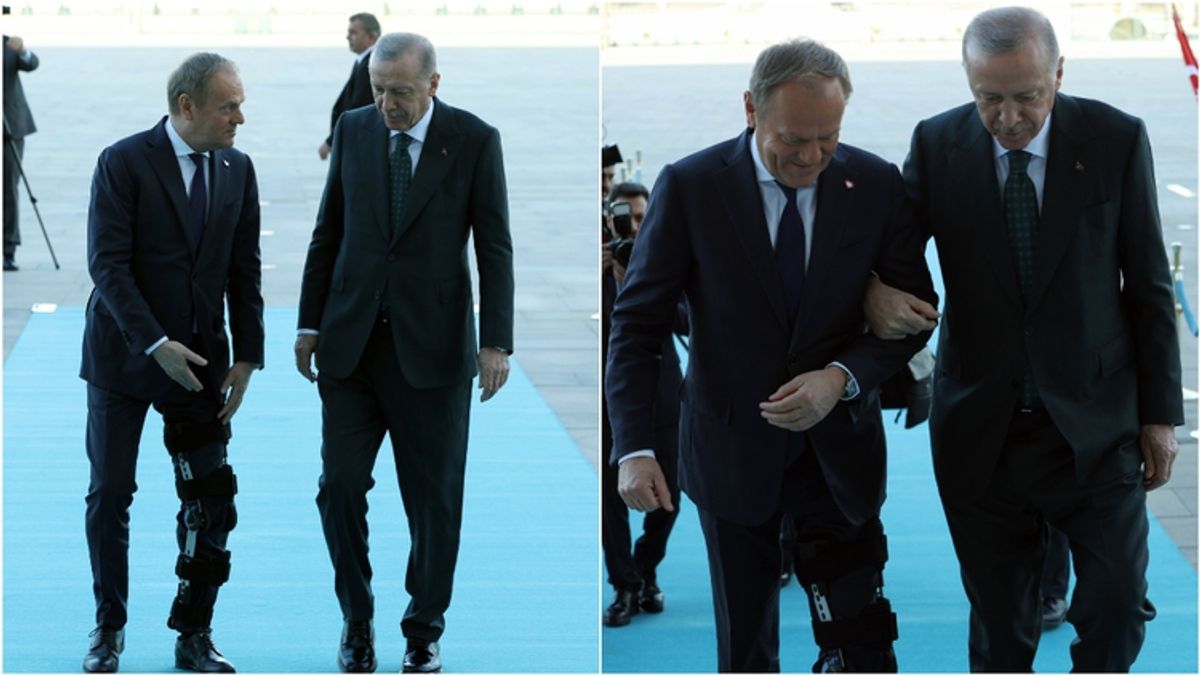
During the meeting in Ankara, Erdoğan helped Tusk up the stairs due to the latter's leg injury | AA
• Turkey and the EU: NATO secretary-general Mark Rutte has privately urged EU leaders to step up engagement with President Recep Tayyip Erdoğan after years of strained relations, according to officials briefed on his remarks.
- Zoom out: It comes as Brussels explores ways to increase collaboration with Turkey and other non-EU neighbors as part of a massive scale-up of European defence capabilities following Trump’s threats to withdraw US security guarantees to European NATO allies.
- Furthermore: Polish PM Donald Tusk said he reached a “historic breakthrough” with Recep Tayyip Erdoğan on Wednesday during a meeting in Ankara, as he tried to convince the Turkish president to play a role in securing peace between Ukraine and Russia.
• Call with Trump: Turkish President Erdoğan and Trump held first ever phone call since the latter assumed office in January.
- Highlights: Erdoğan said Turkey supports Trump's direct steps to end the war between Russia and Ukraine. He added that it is important for US to lift sanctions against Syria for normalization, and this would allow Syrians to return to their homeland.
- Furthermore: Erdoğan called for US to end CAATSA sanctions against Turkey, finalize the F-16 procurement process and finalize Turkey’s re-participation in the F-35 program.
EUROPE
• Bosnia on the brink: Bosnian state prosecutors on Wednesday ordered the arrest of Serb separatist leader Milorad Dodik and his aides for ignoring a court summons, a move which Dodik pledged to resist with help from Russia in a widening standoff over the fragile country.
- What happened? Dodik, the president of Bosnia's autonomous Serb Republic, was sentenced to a year in jail and banned from holding office for six years in a court ruling for defying rulings by the international envoy to Bosnia, whose role is to prevent the multi-ethnic Balkan state slipping back into conflict. In response, Dodik initiated laws barring state judiciary and police from the region.
- Looking ahead: The state prosecutors' office then opened an investigation into what it described as an attack on constitutional order. NATO Secretary-General Mark Rutte pledged the military alliance’s “unwavering” support for Bosnia and Herzegovina’s federal government.
- Big picture: The dispute, which pits Dodik and his allies Russia and Serbia against the United States and the European Union, is one of the biggest threats to peace in the Balkans since the 1990s conflicts that followed Yugoslavia's collapse.
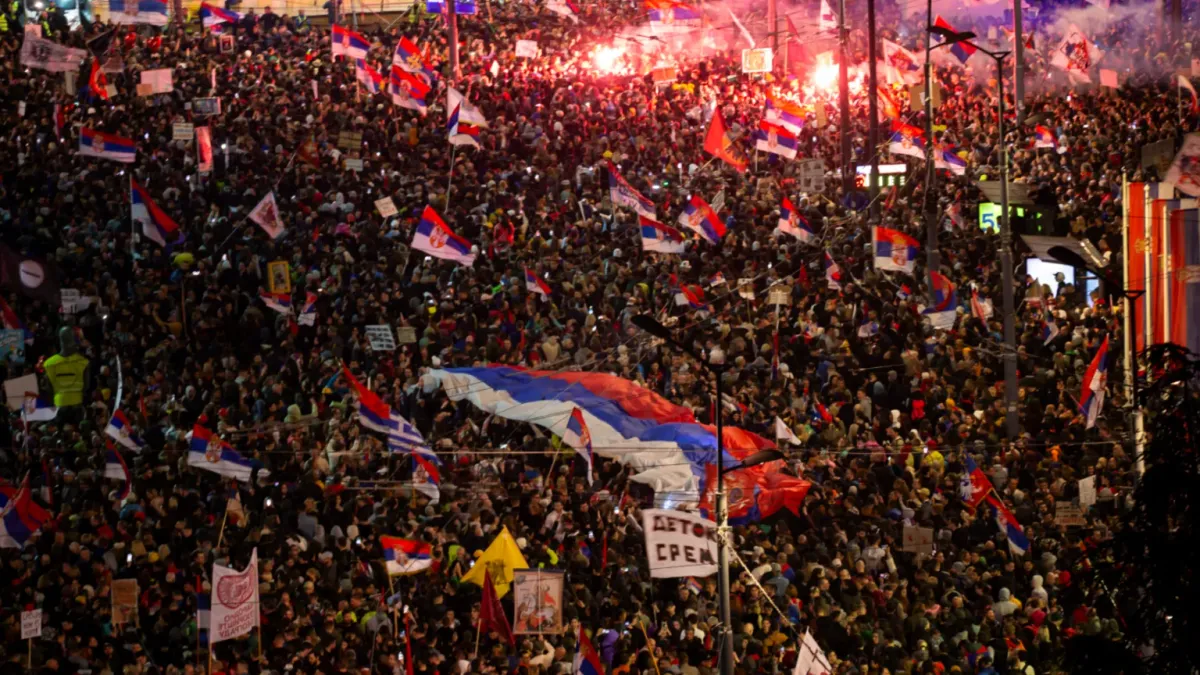
A specialized non-government organization estimates between 275,000 and 325,000 attended the rally, making it the largest in Belgrade's history | Getty Images
• Serbia protests climax: A vast demonstration of more than 300,000 people has gathered in Belgrade, marking the climax of more than four months of student-led protests and the biggest challenge to President Aleksandar Vučić in the 11 years of his increasingly authoritarian rule.
- What they're saying: Vučić stoked tensions in the run-up to yesterday’s mass protest, suggesting there would be an attempt to overthrow him by force and calling it an “imported revolution” with the involvement of western intelligence agencies, but he provided no evidence for the claims. The demonstrations against government corruption and incompetence have so far been overwhelmingly peaceful.
• Romania's election chaos: Chaos broke out in Romania’s capital Sunday evening as enraged supporters of populist Calin Georgescu protested the electoral body’s decision to reject his candidacy in a presidential election redo.
- Some background: Georgescu, a fierce EU and Nato critic, shot to prominence last November when he unexpectedly topped a first round of presidential voting. But the constitutional court annulled the election after claims of Russian interference and a “massive” social media promotion in his favour.Earlier in March, the electoral bureau barred Călin Georgescu, an independent who was polling at about 40% before the rerun election.
- Furthermore: Romania’s electoral commission on Saturday excluded a second far-right hopeful, Diana Șoșoacă, from May’s presidential election, amid rising tension in the run-up to the May rerun of the poll.
- Recommended read: Romania's annulled elections: Putting democracy to test | Aposto World, Serkan Köybaşı
• Greenland's choice: Greenland's centre-right opposition Democratic Party, which favors a gradual approach to independence from Denmark, has won a surprise general election victory in a vote dominated by independence and US President Donald Trump's pledge to take over the semi-autonomous territory.
- Looking ahead: Democratic Party leader Jens-Frederik Nielsen, who is likely to be Greenland's new prime minister, is now negotiating with other parties to form a coalition.
- Driving the news: Three days after the election, Greenland's leading political parties have issued a joint statement to condemn Donald Trump's "unacceptable behavior", after the US president seemed to escalate his campaign to take over the island.
• Austria's direction: The new Austrian government ordered an immediate halt to family reunifications for asylum claimants on Wednesday as it seeks to address widespread concern about immigration that has stoked support for the far-right.
- What happened? Invoking European Union emergency provisions relating to national security, the three-party coalition said it was temporarily freezing all follow-on rights for family members of people granted asylum in Austria.
- A step back: Chancellor Christian Stocker of the centre-right People's Party (OVP) took office earlier this month after the longest-ever stretch of negotiations to form a government in Austria's postwar history. That followed a September parliamentary election victory by the far-right Freedom Party (FPO). The FPO won with about 29% of the vote but failed to agree a ruling coalition, opening the door for the OVP to govern with the centre-left Social Democrats (SPO) and liberal Neos.
• Albania's TikTok ban: Albania’s opposition Saturday protested the left-wing government’s decision to shut down TikTok, calling the move censorship ahead of May 11 parliamentary elections.
- A step back: Last week, the Albanian Cabinet decided to shut down TikTok for 12 months, blaming the popular video-sharing platform for inciting violence and bullying, especially among children.
US
• Tariff wars here: The EU responded to the 25% steel and aluminium tariffs by saying it would raise its levies on up to $28bn worth of US goods, including boats, bourbon and motorbikes, from 1 April. In response, Trump threatened a 200% tariff on alcohol from EU countries unless a "nasty 50% tariff on whisky" is stopped.
- What they're saying: "We're going to take in hundreds of billions of dollars in tariffs, and we’re going to become so rich, you’re not going to know where to spend all that money," Trump said on what new tariffs would mean for the future of the US economy. Some European producers warn the alcohol tariff would be "devastating", and a US distilleries trade group says "we want toasts, not tariffs."
• Rutte meets Trump: NATO Secretary-General Mark Rutte laid on the praise for President Donald Trump on Thursday as the two met in the Oval Office at a time when the president’s comments have raised doubts about his commitment to the transatlantic alliance and its mutual defense treaty.
- The Quote: Rutte welcomed Trump’s efforts to get fellow members of the alliance to step up their defense spending and told the president, “I think they want to work together with you in the run-up to the next summit to make sure that we will have a NATO, which is newly invigorated under your leadership.”
- What they're saying: “I think it will happen,” said the US president, when asked about his vision for the potential annexation of Greenland. Rutte, for his part, said he did not “want to drag NATO” in the discussion, but acknowledged Greenland’s importance for Arctic security in light of Chinese and Russian interests.
- In other news: “It’s normal if the war would have stopped for Europe somehow, step by step, and also for the US, step by step, to restore normal relations with Russia," Rutte said in an interview with Bloomberg on Friday.
• "Antisemitism" charges against Columbia protests: US immigration agents arrested a Palestinian graduate student who has played a prominent role in pro-Palestinian protests at New York's Columbia University as part of U.S. President Donald Trump's promised crackdown on some anti-Israel activists. Mahmoud Khalil, a student who holds a green card, was arrested by U.S. Department of Homeland Security agents at his university residence on Saturday evening.
- Furthermore: A second activist who participated in pro-Palestinian protests, Leqaa Kordia has been arrested as well. Another student, Ranjani Srinivasani, who has Indian citizenship, chose to "self-deport" by leaving the US earlier this week.
- In other news: The Trump administration is immediately pulling $400m of federal funding from Columbia University, saying it failed to fight antisemitism on campus.
- Driving the news: The US Justice Department is investigating whether Columbia University concealed “illegal aliens” on its campus, one of its top officials said Friday, as the Trump administration intensified its campaign to deport foreigners who participated in pro-Palestinian demonstrations at the school last year.
MIDDLE EAST
• HTS-SDF deal: Syria’s transitional government has reached a significant agreement with the Kurdish-led Syrian Democratic Forces (SDF) to integrate the SDF into the country’s new armed forces. The deal, signed by interim President Ahmed al-Sharaa and SDF leader Mazlum Kobane, emphasizes the unity of Syria’s territory and rejects any form of division.
- Some background: The agreement comes after years of efforts by the Syrian government to incorporate various armed groups, including the SDF, into the new Defense Ministry. Although the SDF played a key role in the fight against the Islamic State and has long been backed by the United States, the deal could help ease tensions with Turkey, which views some Kurdish factions within the SDF as linked to the PKK, a designated terrorist group.
- Big picture: The deal highlights the transitional governments hope to rebuild Syria as a unitary state.
- Highlights: The eight-point agreement recognizes “the Kurdish community as an integral part of the Syrian state” and emphasizes that the constitutional rights of all Syrians are guaranteed through a definition of citizenship that includes Kurds. The transfer of SDF-controlled natural resources and prisons to the government and the SDF's armed forces supporting the government are also among the most prominent clauses.
- In other news: Turkey’s top diplomat, defense minister and intelligence chief paid a sudden visit to Damascus on Thursday, days after Syria’s interim government reached a deal to integrate the US backed Kurdish-led armed group into the country’s army.
• Syria's roadmap: Syria's interim President Ahmed al-Sharaa has signed a constitutional declaration covering a five-year transitional period, three months after his Islamist group led the rebel offensive that overthrew Bashar al-Assad.
- Further details: The document says Islam is the religion of the president, as the previous constitution did, and Islamic jurisprudence is "the main source of legislation", rather than "a main source", according to the drafting committee. It also enshrines separation of powers and judicial independence, and guarantees women's rights, freedom of expression and media freedom.
• "Genocide" in UN report: A UN inquiry has accused Israel of committing "genocidal acts" in Gaza by deliberately targeting women’s healthcare facilities and using sexual violence as a war tactic. Israel has dismissed the allegations as unfounded.
- Details: The report, released by the Geneva-based Independent International Commission of Inquiry, states that Israel intentionally destroyed Gaza’s primary fertility clinic and blocked essential reproductive healthcare supplies. It concluded that these actions were aimed at preventing births among Palestinians, constituting genocide under international law.
RUSSIA | CAUCASUS
• Ukraine ceasefire: Following high-level talks in Jeddah, the US agreed to immediately restore military aid and intelligence-sharing with Ukraine, contingent on Kyiv’s willingness to enact a 30-day ceasefire—provided Moscow does the same.
- The Quote: Secretary of State Marco Rubio placed responsibility on Russia, stating, “The ball is now in their court.”
- Looking ahead: Donald Trump says he and Vladimir Putin will discuss "land", "power plants" and "dividing up certain assets" when they hold Ukraine peace talks on Tuesday.
- In other news: Ukrainian forces have mostly retreated from Russia's Kursk region, marking the end of one of the most audacious and surprising operations of the conflict.
• Peace deal on the table: Armenia and Azerbaijan agreed to the terms of a long-awaited peace treaty Thursday that could end a decades-long conflict that began with the fall of the Soviet Union.
- Looking forward: Azerbaijan has laid out a few requirements for the deal to be signed, such as Armenia amending its constitution to remove territorial specifications about its orders. Meeting these demands could take some time, given that amending the constitution requires that a referendum be held. The Armenian PM called for a referendum on a new constitution in February.
ASIA-PACIFIC
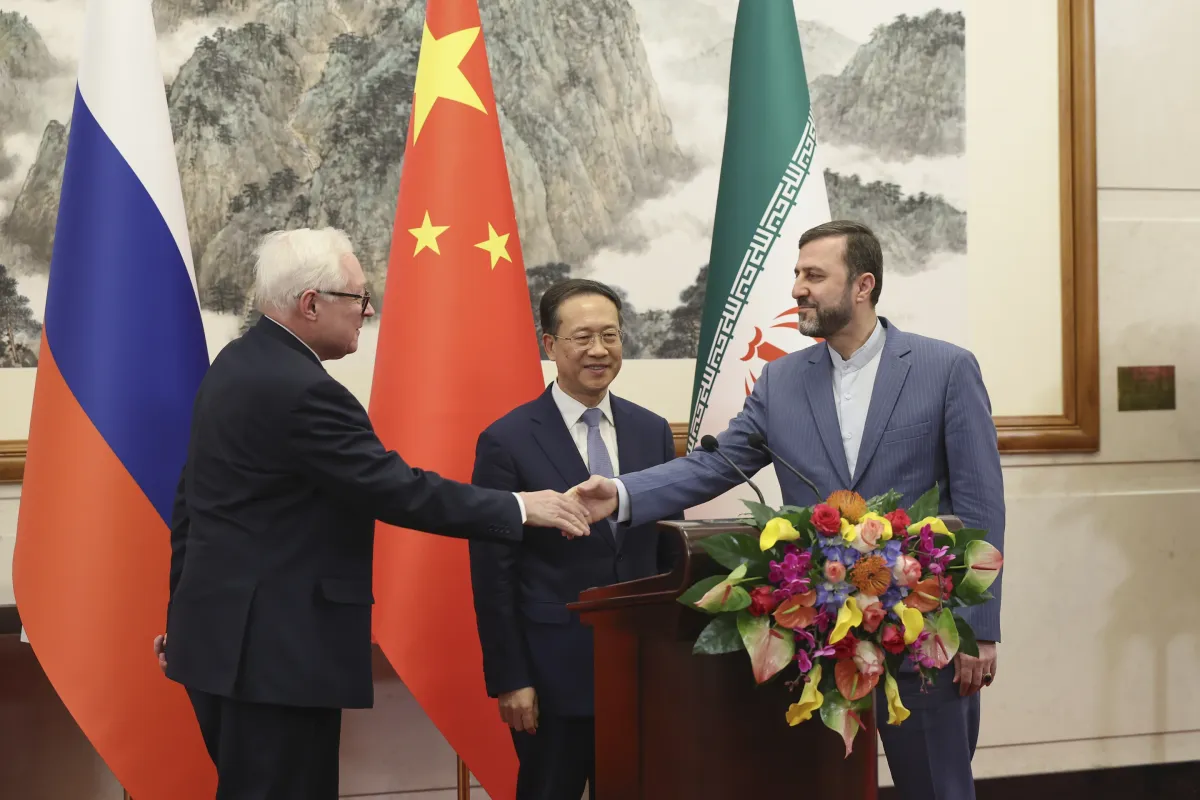
Russian Deputy Foreign Minister Sergei Ryabkov, Chinese Vice Foreign Minister Ma Zhaoxu and Iranian Deputy Foreign Minister Kazem Gharibabadi, March 14, 2025, Beijing, China. | Lintao Zhang/Pool Photo via AP
• The alliance: Representatives of China, Russia and Iran met in Beijing on Friday and called for an end to US sanctions on Iran over its rapidly advancing nuclear program and a restart to multinational talks on the issue.
- A step back: The three countries’ meeting was the latest attempt to broach the matter and come after Trump wrote to Iran’s supreme leader in an attempt to jumpstart talks.
• ICC arrests Duterte: Former Philippine President Rodrigo Duterte departed Manila for The Hague late Tuesday, just hours after being served an International Criminal Court (ICC) arrest warrant over alleged crimes against humanity linked to his deadly war on drugs.
- The Quote: President Ferdinand Marcos Jr. confirmed the flight, stating Duterte would face charges related to the campaign that left up to 30,000 dead, primarily poor urban men.
- Important note: Duterte's supporters argue the ICC lacks jurisdiction following the Philippines' 2019 withdrawal from the Rome Statute. However, the court maintains authority over crimes committed before the withdrawal.
• Taiwan tension: Taiwanese President William Lai Ching-te has accused China of intensifying espionage and infiltration efforts, targeting various sectors of Taiwanese society, including organized crime, media figures, and law enforcement. In response, his government has proposed 17 countermeasures, including stricter vetting of Chinese visitors and enhanced legal actions against espionage.
LATIN AMERICA
• Haiti's ongoing crisis: Haiti’s transitional presidential council appointed economist and former central bank governor Fritz Alphonse Jean as its new leader on Friday, replacing Leslie Voltaire in the council’s rotating presidency.
- Some background: The council, formed in 2024 after gangs overran the capital and forced Prime Minister Ariel Henry to resign, is tasked with governing the country and organizing elections set for February 2026.
- The Quote: Jean described Haiti’s ongoing crisis as a “war,” urging national unity to combat widespread violence, particularly in the capital Port-au-Prince, where gangs control an estimated 85% of the city.
• Sheinbaum exemption: Mexican President Claudia Sheinbaum secured a temporary suspension of US tariffs through diplomatic persistence.
- What happened? Facing Trump’s initial refusal to lift the 25% tariffs, Sheinbaum presented data showing Mexico’s crackdown on fentanyl trafficking and reinforced the benefits of US-Mexico cooperation. Her argument swayed Trump, who announced a waiver for Mexican imports under the US–Mexico–Canada Agreement (USMCA), citing respect for Sheinbaum’s leadership.
AFRICA
• Leaving the Congo: African leaders have announced the withdrawal of troops deployed to eastern Congo under the Southern African Development Community (SADC) mission.
- A step back: The decision follows growing public opposition after M23 rebels killed at least 17 peacekeepers in January.
- Looking ahead: The withdrawal, set to be phased, coincides with planned peace talks between the Congolese government and M23 in Angola.
- Big picture: Meanwhile, the conflict in mineral-rich eastern Congo remains complex, with numerous armed groups, including M23—backed by Rwanda—continuing to battle for control, exacerbating one of the world’s worst humanitarian crises with over seven million people displaced.
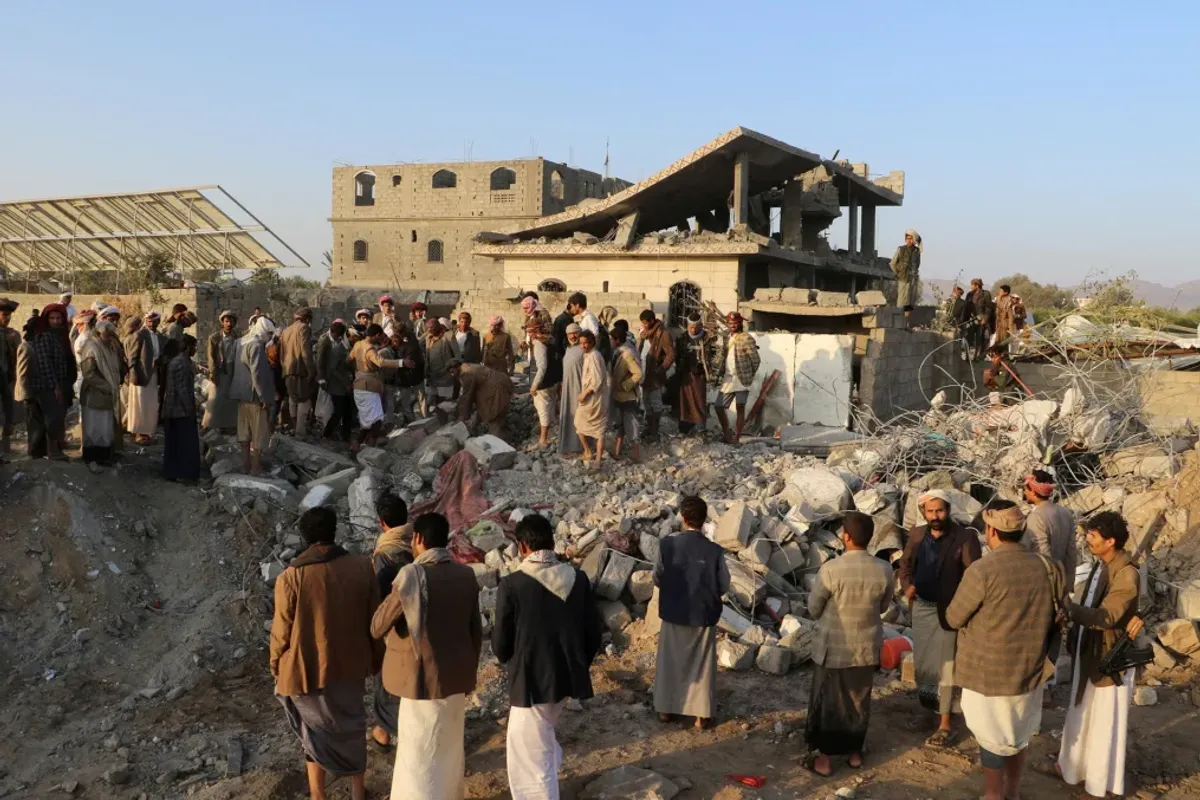
People gather at the site of a house hit by a strike in Saada, Yemen, March 16, on Sunday | Naif Rahma/Reuters
• Trump targets the Houthis: At least 53 people have been killed after US President Donald Trump ordered “decisive” military action against Houthi rebels in Yemen, opening a new salvo against the Iran-backed group that has targeted shipping lanes in the Red Sea.
- A step back: Yemen’s Houthi movement had reinstated a blockade on Israeli vessels in the Red Sea, citing Israel’s continued restriction of aid and electricity to Gaza.
- Zoom out: The strikes, which aim to punish the Houthis for their attacks against Red Sea shipping, are Trump’s first such use of US military might in the region since he took power in January.
• France out: France officially started its military withdrawal from Senegal, transferring two key facilities to Senegalese authorities as part of a broader realignment of its presence in West Africa.
- Zoom out: This move aligns with Senegalese President Bassirou Diomaye Faye’s push to expel foreign forces, echoing similar efforts in Burkina Faso, Niger, and Chad, where pro-West governments were replaced by pro-Russia military juntas.
IN OTHER NEWS
• Tech's nuclear ambitions: A group of big-name companies including Google, Meta and Dow have signed a pledge to support tripling the world's nuclear energy capacity by 2050, a signal of the technology's growing resurgence in popularity.
- Driving the news: It mirrors a similar commitment made by a group of countries including Canada and Turkey at the UN climate conference in Dubai in 2023, and a pledge from a group of financial institutions last year.
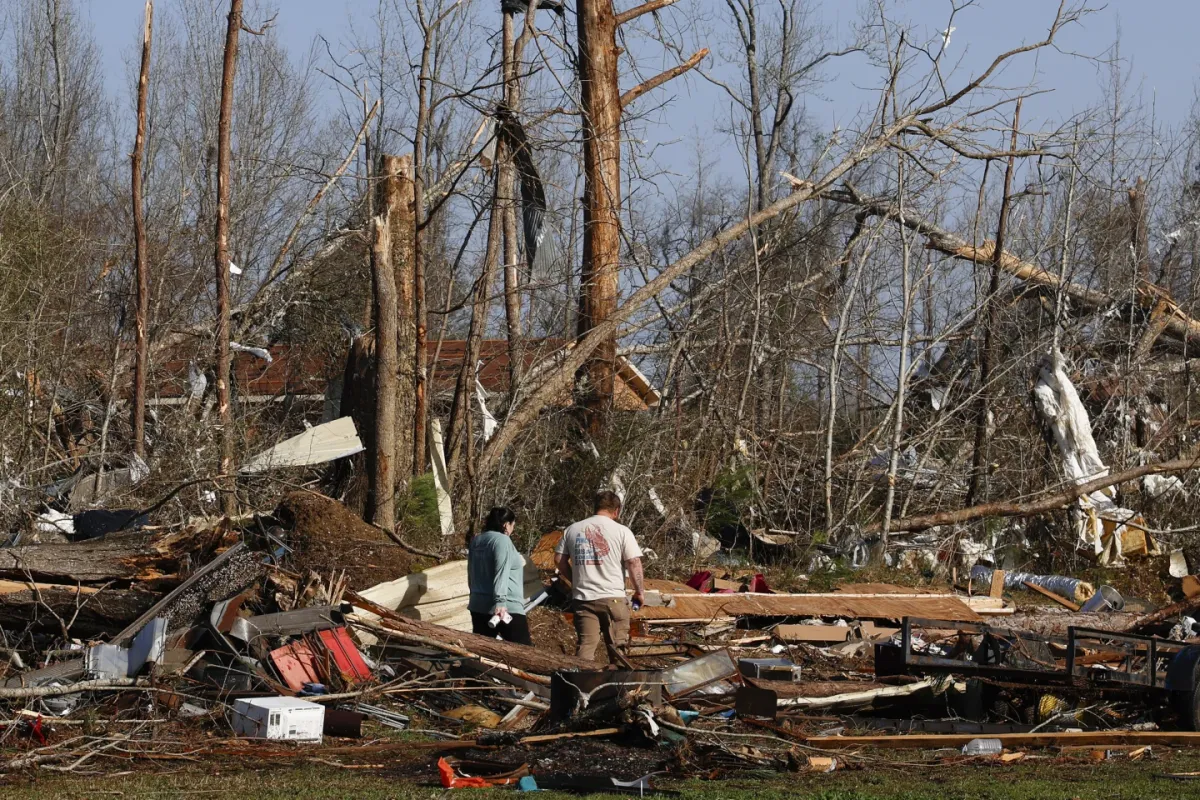
Residents look for personal belongings in the damage after a tornado passed through where two people lost their lives, Sunday, March 16, Alabama | AP Photo, Butch Dill
• US tornadoes: Unusually vicious and damaging weather across multiple US states spawned violent tornadoes, blinding dust storms and fast-moving wildfires over the weekend, leaving at least 39 people dead.
• Macedonia nightclub fire: At least 59 people died and around 160 were injured after a fire tore through a nightclub in North Macedonia, with the country’s interior minister blaming pyrotechnics.
- What happened? Hundreds had gathered at the ‘Pulse’ nightclub in the town of Kochani, east of the capital Skopje, to watch local act DNK perform when the blaze broke out in the early hours of Sunday morning. Interior Minister Panche Toshkovski, announced the casualties at a press conference on Sunday, saying on stage effects triggered a blaze that quickly spread.
- Looking ahead: Arrest warrants have been issued for four people in connection with the nightclub fire, including the owner of the nightclub. 15 people have been detained.
BEFORE YOU LEAVE
From previous issues:
- The anti-LGBTI+ tactic of populist regimes | Serkan Köybaşı
- Öcalan urges PKK to disarm in historic call
- Turkey’s main opposition party to determine its presidential candidate in March
📱Finally: Make sure that you follow Aposto World on Instagram. Also, Aposto's culture and travel brand Soli just launched its monthly print-magazine. You can learn more about the English-and-Turkish magazine and order it here.