Istanbul from 6 to 6 | Beyond Hi-Fi and craft drinks: what a listening bar is, and isn’t
Born in Japan and now spreading across the big cities of Europe and the US, audiophile bars represent the spread of an analogue culture that puts experience, process and quality ahead of uniformity and fast consumption. One of the current versions of this approach, which brings food, drink and music together, is taproomx in Asmalı Mescit. In this instalment of the “Istanbul from 6 to 6” series, Can Çakmakçı, one of taproomx’s partners, tells us how the feel of vinyl and craft beer took the shape of a place.
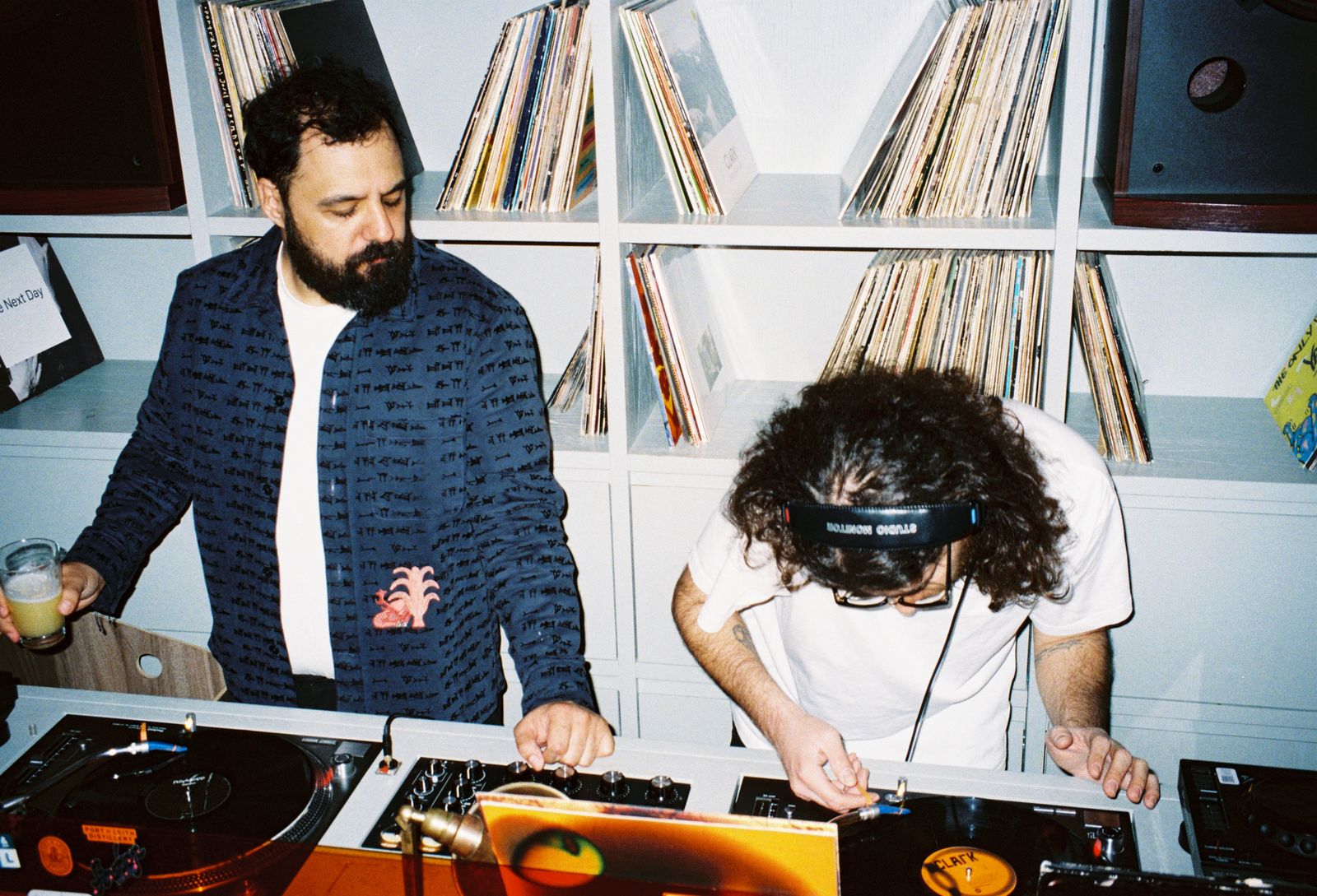
Photographs: Bulat
The audiophile bars that have multiplied in the big cities of Europe and the US, especially since the pandemic, are about more than the aesthetic poses shown off on Instagram. They represent the spread of an analogue culture that puts experience, process and quality first, in response to the uniformity and fast consumption brought by digitalisation.
For the same reason, it should come as no surprise that the concept originated in Japan, a country that has managed to fuse quality, craft and technology in a single crucible. Inspired by early examples such as Japan’s jazz kissa (jazz cafés), listening bars have spread across Europe, mostly combining food and drink with music: small, simple but artisanal plates and craft drinks meet custom-designed Hi-Fi sound systems and music played from vinyl.

Of course, it is important not to call every venue with a good sound system a listening bar. What sets it apart is developing an approach that puts music at the centre and extending that approach to the whole venue. Being part of a cultural movement rather than following visual and aural trends sets it apart too, as, naturally, does prioritising the place music holds in the room...
Today, whether venues like the jazz kissa, where talking is forbidden, music alone is at the centre and coffee or a drink is served, can be economically sustainable, and for how long, and in which city, is open to debate. But the current versions, which combine this approach with bars and restaurants, are already with us as new players in cities’ night-time economies. In Istanbul too...

taproomx is the story of records carried from Ankara to Istanbul, from one end of the world to the other, and of the feel of craft beer taking the shape of a place. Opened in 2023, it made room for Jurnal Sokak to wake up and get its sounds back, and it is one of Istanbul’s first audiophile listening bars to put analogue culture and music at its heart. With the buzz it created on the street together with its now-closed neighbour bordel, and with its home in the building of the former Babylon, it is fair to say it also became a kind of hope for an awakening in Asmalı Mescit.
- Among venues that lose their way and their identity by trying to add a bit of this, that and the other, this is one of the rare places that has secured its standing in Istanbul simply by saying “music from vinyl and craft beer”, putting quality before quantity.

The story of Can Çakmakçı, one of the partners in taproomx and the craft beer brand SOMX, sums up why and how he opened a place like this. In Ankara, among the generation of that time, musical exchange was extraordinarily rich. Can’s father was keen on sound systems and the latest equipment, so from an early age Can found himself surrounded by Hi-Fi systems, records and music culture. As for every music-loving Ankara native, Süleyman Abi, the owner of Shades, became one of the people who shaped his musical understanding. He still buys many of his records from him. At just 17 or 18 he already had a place in Ankara’s club culture, and playing at legendary venues of the time such as Club 20 and Faces became important landmarks on Can’s musical journey.
With that in mind, we ask Can about taproomx, a new player in Istanbul’s night-time economy, and talk about audiophile bars and their place in Istanbul.

Where did the idea come from to open a brewery serving your own SOMX beers that is also a listening bar embracing analogue music culture?
taproomx is a clear reflection of our principles and our passion for brewing. In fact, the whole story was written through making beer. Alongside the finesse and sophistication of our own handcrafted beers, we could not accept the idea of playing music through an ordinary sound system, or of any old hamburger accompanying that beer.
At taproomx we wanted thoughtful details, from music to food, from interior design to ambience, and we wanted to see our approach to brewing in every one of them. taproomx also became a space where the tastes that have influenced and nourished us come together.

What need do you think taproomx meets in Istanbul?
With everything it offers, taproomx is a place that steers clear of stock ideas. None of the things most people first associate with beer are here. You won’t find greasy fried food, progressive rock or amber lighting. Nor are we an “Irish pub” cast from a single mould. As an innovative place that meets global standards, we broke out of the narrow, short-lived cycles and reached a loyal crowd.
Naturally, our musical approach also stayed outside these moulds. People needed a place where they could savour a good beer and the food alongside it while listening to jazz through horn speakers. I think we have brought a breath of fresh air to Istanbul nightlife, both with our approach to music and with the atmosphere.
What is taproomx’s approach to music? How is it reflected in the venue as a whole and in its programme?
Andrew Weatherall, whom I met in person shortly before he died, spent time with and was lucky enough to share a stage with, and who, beyond his musical presence, held an extraordinary place in my life through his wisdom, had a saying I love: “Genres are for journalists.” So I’m grateful you didn’t phrase this as “What kind of music do you play?” Because, to be honest, I don’t know either! In our programmes we do say what kind of music will be played that evening, but that is because people coming to taproomx that night want to know what they’ll find. What happens here goes far beyond a musical genre.
I can sum up my approach to music at taproomx with one question: “If taproomx were a person, what music would it enjoy listening to?” There is a shuffle built entirely around the feeling that question brings. And just like a person, taproomx has its own musical phases.
Of course we have a playlist, and it is updated very often in keeping with that feeling. Beyond that, we host different DJs on certain days of the week. These bookings answer the question “If taproomx were a person, who would it enjoy being friends with?” And that feeling brings with it a remarkable musical range.

Analogue culture: from jazz kissa to listening bars
Listening bars, whose roots go back to Japan’s jazz kissa and to bars equipped with Hi-Fi systems designed purely for listening to music, have become very popular in Europe, especially over the last 5 years. Everywhere you look there are lists of listening bar picks for audiophiles. First of all, what is a listening bar to you, and what isn’t it?
Roughly speaking, listening bars are places equipped with the Hi-Fi qualities you mention, usually playing jazz selections from vinyl, where audiophiles socialise and meet not only to talk but also to listen to music. There is, of course, a particular reason this movement came out of Japan. As in many fields, Japan is the world’s largest exporter of sound systems. By combining the depth of their craft culture with their pioneering role in Hi-Fi technology, they gave us a wonderful gift. As you say, the movement has become very popular in Europe too, especially in the last 5 years, and has taken shape there with its own interpretation.
We can call a listening bar any venue that, regardless of the genre it plays, has a Hi-Fi sound system above a certain standard, puts music at its centre and mostly plays music from vinyl. Places that don’t meet these standards but try to achieve the same look can’t be called listening bars. Being fitted out with vintage systems doesn’t make a place a listening bar. Nor is there any value in a sound system being custom-built or custom-designed if it doesn’t deliver good sound quality.
For a listening bar to be a “listening bar”, above-standard sound and atmosphere must come together. In Istanbul, Arkestra’s Listening Room, Mezkla, Outro (though it isn’t a bar) and, in Ankara, Stir are the places I enjoy most as an audiophile. Among good examples around the world I would name places such as Coltrane Coltrane, Rhinochiros, Public Records, Brilliant Corners and Bambino.

Looking at them, most venues that stand out as listening bars share similarities in menu and approach: small, comforting but characterful plates, natural wine or craft beer, and interior design that showcases the sound system. What relationship do you see between these approaches? What are the subtleties of creating a venue that prioritises listening to music?
The Hi-Fi approach is definitely also an idea of comfort in life, and naturally it brings these shared qualities with it. It includes an understanding of a good natural wine, of the simple but deep aromas of a craft Bohemian pilsner, and of gastronomic layers. And that brings a shared stance with it.
But having these features doesn’t make a venue a listening bar either. Nor does simply installing a very good sound system turn a place into a “music-first” venue. You become a music-first venue if you can complete a fabric woven from details in which you are strong right down to the weakest link: the positioning of the system, the room acoustics, the materials used on the ceiling and floor, the table layout, the quality of the cabling, the phase of the electrical supply. Prioritising the sound system shouldn’t just be for show.

Why do you think listening bars, which have existed since the 1920s, are popular again, and right now? Is it accessibility, a passion for analogue, or a growing need for experience-led venues? How would you read it through dynamics like these?
What is spreading is really a feeling and a stance. That is also what is reviving the passion for analogue you mention. Music that seems to come off the same production line, and the easy consumption that comes from the easy access brought by digitalisation (whose benefits are, of course, endless), are what triggered this.
Experiences confined to a narrow space, and the colourlessness and uniformity brought by industrialisation, led to the rise of handmade and limited production, record collecting and analogue photography: in other words, of pursuits that prioritise process and quality. The listening bar concept offers, in its most aesthetic form, an atmosphere and experience in which all of these melt together. So it is a natural answer to this search.
In search of quality: Istanbul’s audiophile bars
With an approach that puts experience at the centre, listening bars, cocktail bars, breweries and comedy clubs, although actually quite old concepts, have become new players in Istanbul’s night-time economy. In this context, what role could listening bars play in Istanbul, at the intersection of the night-time economy and music, in the coming years?
There is a rise of analogue culture against hollow innovation. That is why the concepts you mention are on the rise. This needs to be read correctly. The audience isn’t really looking for novelty; it is looking for quality. Many older concepts have that quality; they just need updating for today. Once there is the sustainability to keep the right examples going, I expect a revival in Istanbul. Of course, the audience that wants these venues also needs to support the people who take the risk. All of us, as operators and as customers, need this vitality in Istanbul. It is a matter of culture.
Istanbul has undoubtedly been shedding its skin lately. But businesses with deep pockets, reading this as a new trend, have already started snapping up the prime spots. So the real mistake is to read it as a trend. Hollow, cookie-cutter places run by those who see it as a trend are multiplying fast. I hope we soon get to know braver, younger businesses.

Most listening bars in Istanbul and Europe are examples of music and gastronomy coming together. In a city like Istanbul, what are the future, the advantages and the disadvantages of this pairing?
Istanbul’s hallmark is its tremendous motion. My hope is that concepts that go beyond copy-paste and add our own interpretation will multiply in Istanbul. That is where I see the future. The audience needs both this difference and this closeness.
On the other hand, setting up a Hi-Fi system costs many times more than a sound system that would meet the needs of any bar or restaurant. Add the costs of location and aesthetics, and unfortunately it isn’t easy for the number of true listening bars to grow. That is the only disadvantage I see.
How might the spread of listening bars, and of the search for quality in music, affect the city’s music culture? For example, what might listening bars’ relationship with the city’s record shops change for those shops?
It is encouraging to see the record culture I witnessed, especially in the years I grew up, rising again. That matters because it means more in-depth conversations about music through records. For the sector, it can also encourage record shops to revive and, in turn, a wider variety of records. Of course, the economic side matters too. Right now a new record costs a tenth of the minimum wage. Sadly that is a lot, and it doesn’t make records accessible to everyone. On the other hand, there are a great many records and record collectors in Türkiye. Listening bars are valuable for getting those records off the shelves, too.
I also hope the listening bar concept won’t remain the monopoly of bars and restaurants. Outro and eksibir are doing pioneering work here. Of course, as with everything that becomes popular, there will be bad examples in this field too, but I’m sure the audiophile crowd will gravitate towards the right ones.
The legacy of Jurnal Sokak
What kind of music venues do you think Istanbul, and Beyoğlu and Asmalı Mescit in particular, need?
Culturally, Beyoğlu is at the tip of the spear. The most precious and the sharpest. That is why it is also very fragile. All eyes are on it. Asmalı Mescit is the spot that feels these shifts most harshly. Here we have a remarkable cultural heritage and memory of place. Rather than going backwards, we should try to build on the gifts of the past. In music, I would really like to see places that embrace this approach. We are in a space where all differences are accepted. We should make the most of this diversity.

taproomx is housed in the former Babylon building. What mission does being on the site of one of the most important legacies of Istanbul’s music scene, and in this neighbourhood, give taproomx?
By opening taproomx in this building, I think we have taken a step towards reviving the memory of Asmalı Mescit and of the venue. Especially since the years when Beyoğlu began to grow culturally barren, the transformation of Asmalı Mescit has been one of Istanbul’s important issues. Of course, we came here feeling a responsibility, and our greatest inspiration is the memory of the place we are in. Jurnal Sokak is a remarkable legacy in its own right. Aware of this, we exist here by embracing the neighbourhood culture of Jurnal Sokak, from its oldest residents to its newest, by respecting its legacy and by being embraced by the neighbourhood.
Previous articles in the ‘Faces of the night in Istanbul’ series: