


Good morning. Today is Thursday, August 18th.
Today we follow the UK consumer price index hitting a new 40-year high, while the world's largest sovereign wealth fund in Norway reports a $174 billion loss in the first two quarters. In the meantime, Germany's energy regulator said their natural gas reserves would only cover less than 3 months of demand if Russia cuts off supplies once and for all. It seems like everyone is pretty much deep in the water right now.
Here are some laid-back beats that will certainly boost up your mood that some of today's news might bring down. Now hit that play, scroll down, and get your daily dosage of news!
– Tanem, with Atilla and Can
 Aposto World
 is our English-language briefing on the news that matters around the world, written by the Aposto newsroom in Istanbul. Every Monday and Friday morning we go through the international press, region by region: the UK, Europe, the US, the Middle East, Africa, Asia-Pacific and the rest of the world, with a closing section on culture, science, technology and sport. Each story is told in a few clear lines with the context you need, and links to the original reporting so you can read further. One email, twice a week, and you are up to date.
• Seasonally adjusted GDP in the Eurozone rose by 0.6% in Q2 2022, according to the data from Eurostat. Eurozone GDP increased by 3.9% annually, down from an initial reading of 4.0%.
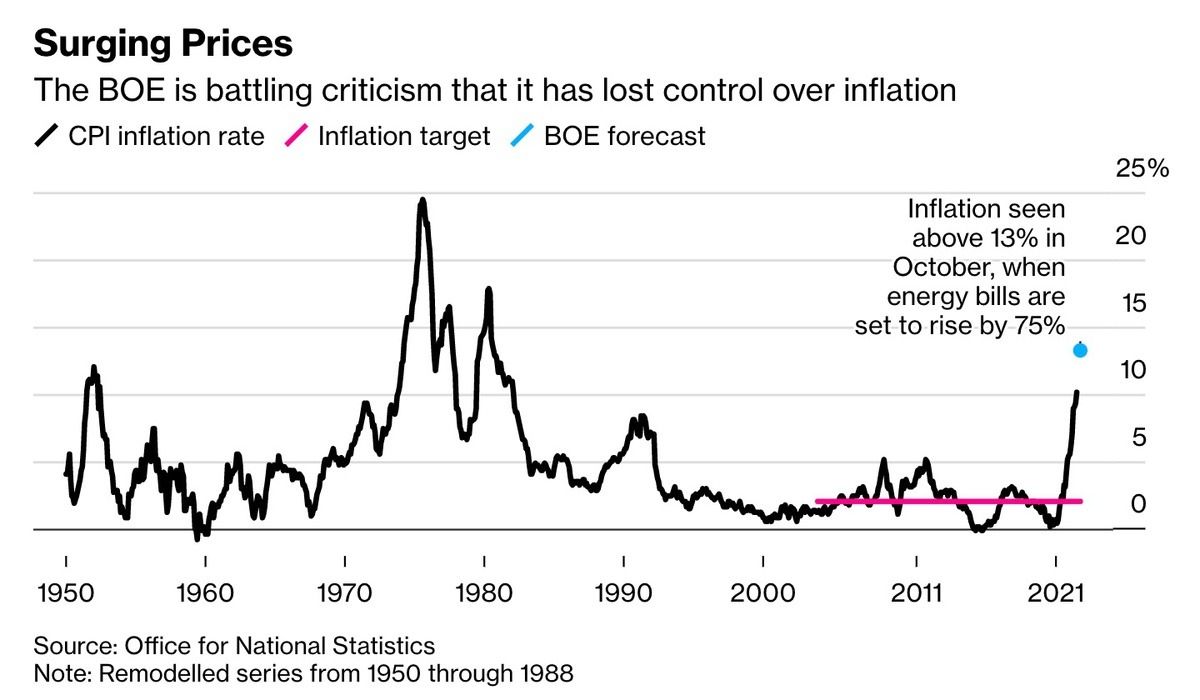
• UK consumer price index hit a new 40-year high of 10.1% YoY in July, up from 9.4% in June. Core inflation, which excludes energy, food, alcohol and tobacco, came in at 6.2%, ahead of projections of 5.9%. The Bank of England expects inflation to top out at 13.3% in October.
via Bloomberg
• US inflation pressures showed “little evidence” of easing late last month, according to the minutes of the rate-setting Federal Open Market Committee’s July 26-27 policy meeting. Policymakers steeled themselves to raise rates as high as necessary to bring inflation under control, acknowledging that they would have to engineer less spending and lower overall growth for that to happen.
- Zoom in: Some participants said they felt rates would have to reach a "sufficiently restrictive level" and remain there for "some time" in order to control inflation, which is running at a four-decade high. The pace of future hikes would depend, the minutes said, on incoming economic data, as well as Fed assessments of how the economy was adapting to the higher rates already approved.
• German natural gas reserves would only cover less than 3 months of demand if Russia cuts off supplies completely, even if gas inventories are replenished in line with government targets, according to Klaus Mueller, head of Europe’s biggest economy’s energy regulator. Stockpiles are currently 77% full, which is two weeks ahead of schedule.
- In other news: The water level at Kaub, a key German waypoint on the Rhine River, is forecast to rise above a critical level this weekend, potentially bringing a sliver of relief for shippers of vital commodities through inland Europe.
• Europe’s declining fertilizer output is threatening to raise prices and tighten supplies in more fragile agricultural markets, potentially cutting global fertilizer usage as much as 7% next season, the most since 2008, the International Fertilizer Association warns.
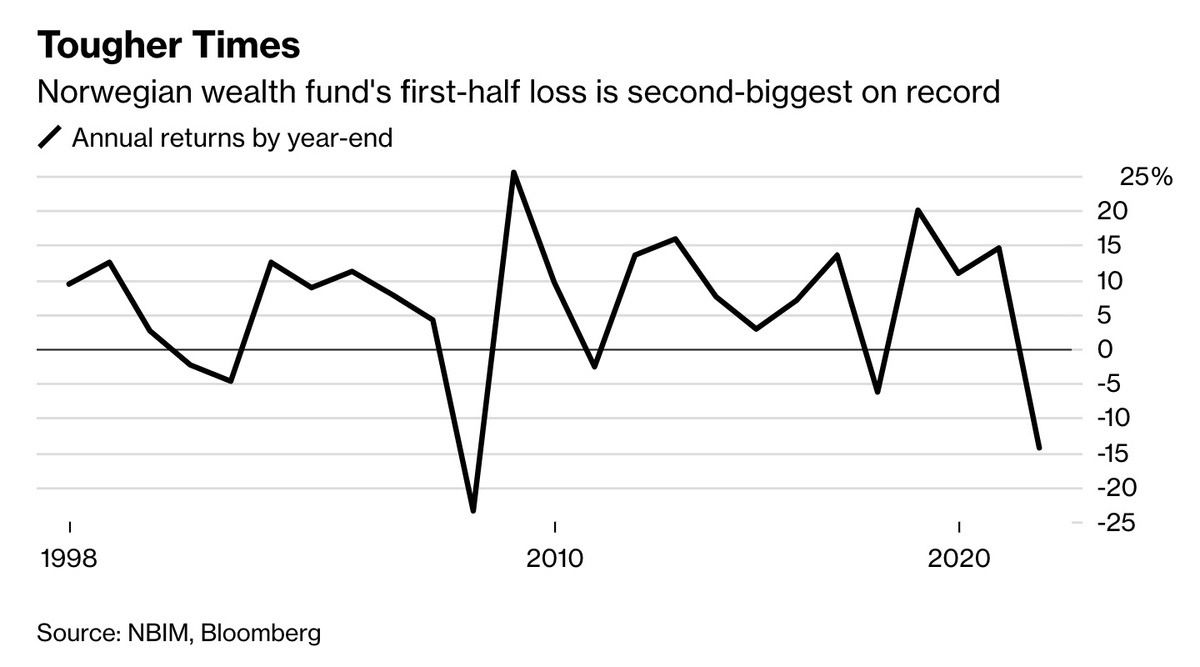
• The Government Pension Fund of Norway, the world’s largest sovereign wealth fund, reported a $174 billion loss in the first two quarters with Meta, Amazon, Apple and Microsoft being the biggest single contributors to the decline — as the $1.3 trillion fund returned a negative 14.4% during the period, citing "rising interest rates, high inflation, and war in Europe."
via Bloomberg
- Behind the scenes: The fund’s total return, however, was 114 bps higher than that of the benchmark against which it measures itself, Nicolai Tangen, the CEO of Norges Bank Investment Management said in a statement. Dow Jones lost more than 15% during the same period while S&P 500 was down over 20% and the Nasdaq Composite fell almost 30%.
• German utility Uniper reported a €12.3 billion loss due to Russian gas supply cuts, which accounted for around 55% of its total imports last year, and the costs of switching to alternative sources — saying it had become a "pawn" in the energy standoff between the EU and Moscow.
- A step back: Germany agreed last month to bail out the largest importer of Russian gas, taking a 30% equity stake in the company in a €15 billion rescue deal.
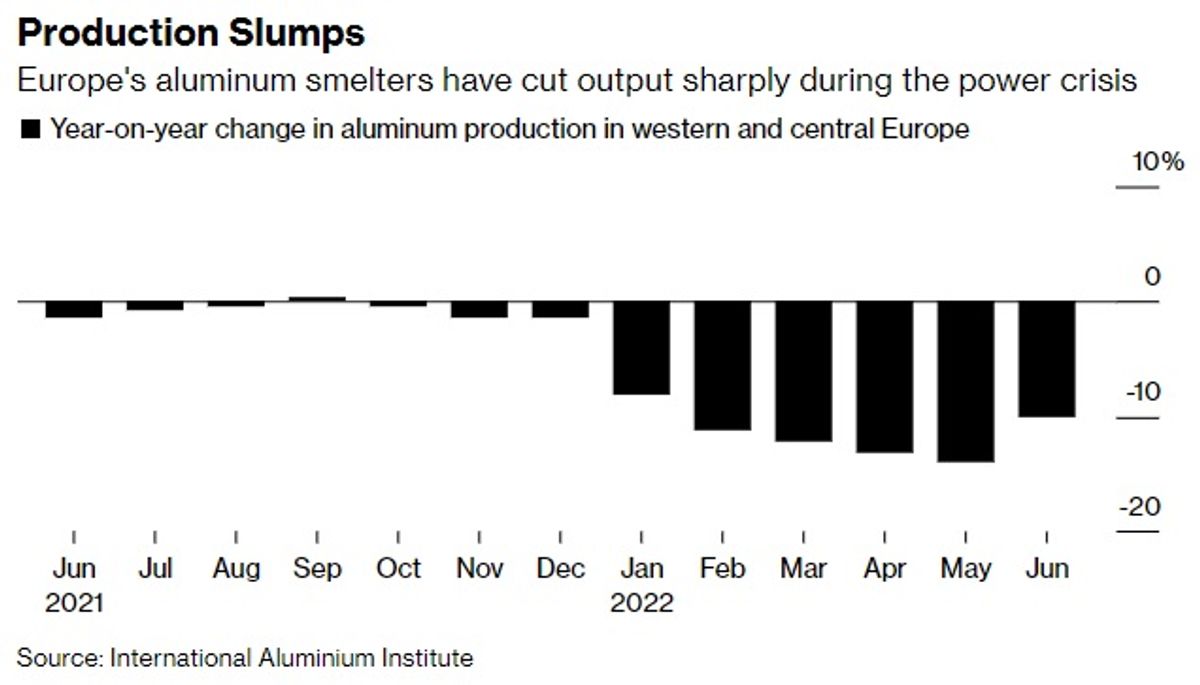
• Norsk Hydro is planning to shut down an aluminum smelter in Slovakia by the end of this month as Europe’s energy crisis continues to cripple metal producers. The Slovalco smelter was running at 60% of its 175,000-ton annual capacity and would suffer substantial losses if it continued operations beyond 2022, the Norwegian firm said, as aluminum is one of the most energy-intensive metals to produce.
via Bloomberg
- A step back: Europe had already lost about half of its zinc and aluminum smelting capacity during the past year as producers dialed back output. The Slovalco facility is the first to shut down entirely.
• Tencent, the $370 billion Chinese tech giant, posted a revenue of 134.03 billion Chinese yuan (€19.4 billion) in Q2 2022, its first-ever YoY revenue decline with a decline of 3% year-on-year as stricter regulations around gaming in China and the Jinping admin's zero-covid policy hit the technology giant.
• Danish pharmaceutical Bavarian Nordic, maker of the only approved vaccine for monkeypox, said it’s no longer certain it can meet demand and is talking to multiple production partners as cases rise across the world. The company is exploring the possibility of outsourcing some of its production, including a technology transfer to a US contract manufacturer, to meet accelerating demand.
• Ukraine's President Volodymyr Zelenskiy warned citizens to keep away from military facilities in Russian-occupied areas, following the ammunition depot explosion on Tuesday. Zelenskiy is expected to meet with Turkey's President Recep Tayyip Erdogan and UN Secretary-General Antonio Guterres today to discuss "possible steps to end the war through diplomatic means," according to a statement from the Turkish presidency.
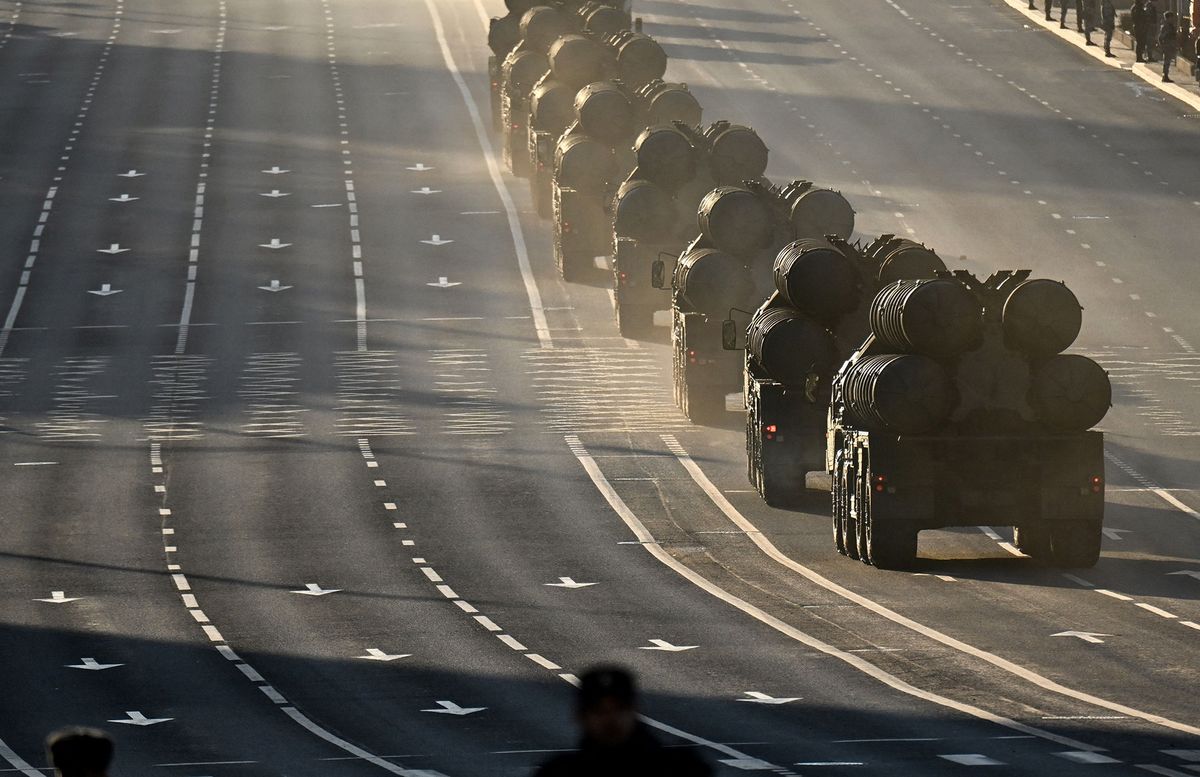
• Russia’s Federal Service for Military-Technical Cooperation said they signed a contract with Turkey to supply additional S400 air-defense missiles, but Turkey's Defense Ministry denied that a second purchase agreement was signed. Russia said that the new contract includes local production in Turkey for some components of S-400s, but Ankara said there hasn't been any change in terms since an initial deal was signed in 2017.
via Bloomberg
- A step back: Turkey's initial 2020 purchase of Russia's S-400 system angered the US which resulted in Washington imposing sanctions on their NATO ally's defense officials in retaliation.
• Sweden proposed new handouts to homes as surging energy prices threaten Prime Minister Magdalena Andersson’s chances of re-election on Sept 11. The proposal aims to use some $5.8 billion to compensate households and companies for record prices as a result of Russia’s curbs on energy exports to Europe. Under the new proposals, homes can expect about three times as much as the one-off handouts from last winter.
⚡ Lightning Round
- Germany's chancellor Olaf Sholz slammed Palestine's President Mahmoud Abbas for accusing Israel of committing "50 Holocausts", saying that he was "disgusted by the outrageous remarks" made by Abbas.
- The UK launched a formal appeal against getting excluded from EU scientific research programs, using a provision in the post-Brexit agreement, the first such challenge to the EU bloc since Brexit.
- Taiwan started holding opposing military exercises in the island's southeastern region, following new rounds of threatening drills from China after the congressional visits from the US to the island.
• The European Central Bank said on Wednesday that it would be “taking steps to harmonize” how banks offer crypto assets to ensure they have enough capital and expertise, ahead of pan-EU licensing rules to regulate the crypto market that are expected to enter effect in 2023 at the earliest.
- The quote: "In Germany, certain crypto activities are subject to a banking license requirement and to date, several banks have requested to be authorized to conduct these licensed activities," the ECB said in a statement. "It is in this context that the ECB is taking steps to harmonize the assessment of licensing requests."
• Twitter has to “collect, review, and produce documents” from the former head of consumer product Kayvon Beykpour, ruled Judge Kathaleen McCormick, handing a partial win to Elon Musk’s lawyers in Twitter’s lawsuit against Musk for trying to break up their $44 billion buyout deal. The trial will be held on Oct. 17.
• Oracle is reviewing TikTok's algorithms and content moderation models in a bid to make sure Chinese officials aren't manipulating it in any way. The social media platform, owned by China’s ByteDance, is in the process of moving all of the data it has on US users to Oracle cloud storage based in the country.
• WhatsApp’s new app on Windows no longer requires you to link your phone to send, receive, and sync messages. As opposed to the previous web-based desktop app or accessing the service from a web browser, the new app is native to Windows, which, as WhatsApp explains, should make the app faster and more responsive.