



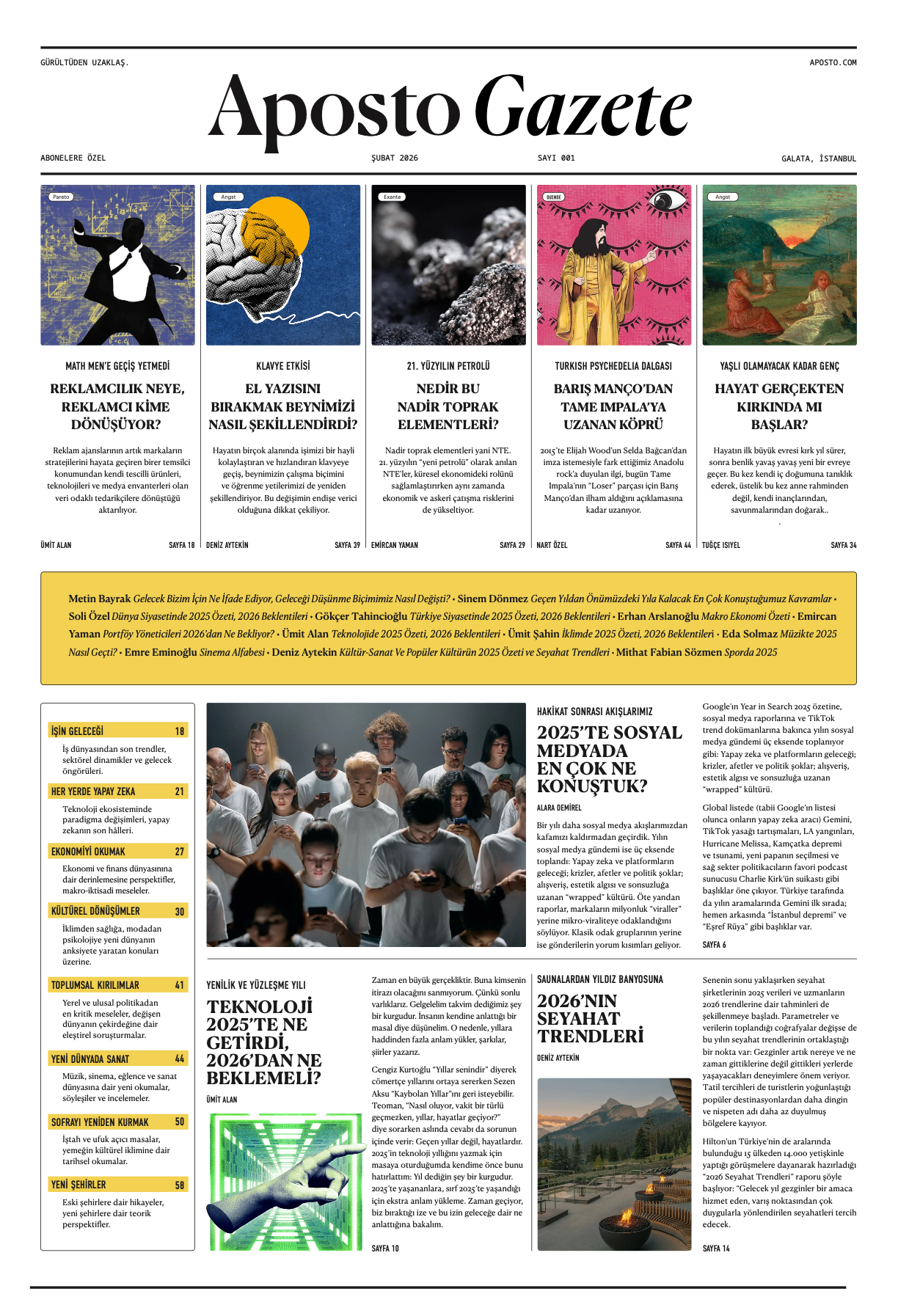


Brian Cox's Guide to the Galaxy


 Aposto Gündem
Her sabah 06.30'da 5 dakikalık gündem özeti e-posta kutunda. Piyasalar, ekonomi, iş dünyası, politika, teknoloji ve hafta sonu ekleri; kısa, yalın, öz bir şekilde.
Brian Cox has been famous for a minute: the academic (he is a professor of particle physics at the University of Manchester), TV personality (host to “Brian Cox’s Adventures in Space and Time” and once a guest star on Doctor Who for those who remember), musician (he once famously collaborated with The Cure) and creator of “Horizons”, the audiovisual experience over which Cox talks about the story of our universe is prolific and tireless. Unparalleled in explaining physics to general audiences, Cox is a remarkable science communicator and has been described as the natural successor for the BBC’s scientific programming by none other than David Attenborough.
Ahead of his show in Istanbul on April 19, we got together and talked about the importance of understanding the world around us, what space colonization actually means, adolescence and time (Spoiler: Cox finds the subject complicated.)
You use analogies like the interchangeability of euros and dollars when explaining mass and energy in physics. Similarly, at Columbia University, there is a course called “Physics for Poets” that fascinates us–essentially, it’s simple physics for right-brained people. How do you think the world would be a different place if more people knew about physics?
I think it would if more people knew about nature in general, not just physics. Scientifically, you could say well you're just a collection of atoms, some of them as old as time, the hydrogen atoms. The rest of them were made of stars. It's in this pattern that we can think, feel, explore the universe and write music and do what we do. So science gives you this valuable perspective. Anybody who studies science thinks about their place in the universe for a moment.
I also always think about one of my great heroes that inspired me, Carl Sagan. He said that our place in the universe is remarkable as there's no one coming to save us from ourselves. So suddenly we have this overwhelming responsibility and you realize as well as being fortunate, that we better not make a mess of this. So the long answer to the question is that science becomes a way of trying to understand our value.
At some point, all children ask the big question of “Where did we come from?” What would you say is the most dignified answer to that question?
Well, you can answer it to some extent. You can tell the history of the evolution of life on Earth and we can speculate to some extent about how it may have begun. And we have some theories and maybe we can test them. That's one of the reasons we're on Mars at the moment, looking to see if life began on Mars. But ultimately you keep going backwards and you get some very deep questions indeed about such as, well, where did the universe come from? Did the universe have an origin? I don't know. I don't even know it began. It might be eternal for all I know. We know there was a bit of this Big Bang thing 13.8 billion years ago. It was really hot and dense. We don't know whether that was the origin of the universe at all.
Richard Feynman, one of my heroes and someone who worked on the Manhattan Project with Robert Oppenheimer and others wrote a wonderful essay called “The Value of Science” in 1955. In it, he made that very statement, “You have to say I don’t know in order to make progress. Because if you think you know everything, you won’t learn anything.”
So I love the idea of saying “I don’t know.” I don't see fear there.
That is a very dignified answer and is really, really humbling. We kind of already started talking about Feynman, Oppenheimer and the ethical complexities in science. How do you think policy makers and government officials should navigate such ethical dilemmas?
That's a great question because you're right in principle. We haven't solved the problem of the bomb. It's true that we haven't detonated one in anger since 1945, but that doesn't mean we're not going to. We've got plenty of them lying around. It's interesting to look back on history. In history, you will see Oppenheimer, for example, trying to argue that the only real way to control that technology was to make it freely available and regulate it globally. We could easily destroy our civilization, and as we've discussed before, in doing so we might destroy all intelligent life in a galaxy forever.
The way that we regulate other technologies like genetic engineering, AI, we can learn lessons from our complete failure to deal with the knowledge that we generated in the 1940s in the Manhattan Project. It's an utter failure that everybody has these bombs now. That shouldn't have happened.
Global regulation is something that we've not solved, although science is good at global collaboration. Boundaries or different beliefs don't really exist in science so much. A great example of that collaboration is what Abdus Salam, a Nobel Prize winner created. He spent half of his life doing fundamental research, almost the other half building an institute called INFN in Italy, which was built specifically to have scientists from all over the world, especially developing countries come and work in it. So a lot of physicists from African nations are there, for example. So it’s not just some kind of romantic desire.
Different nationalities, different belief systems, when these people work together, we would have a greater chance of not only having a harmonious future but solving the problems that we face.
We really do hope so. We are really excited for you to present your show "Horizons" in Istanbul. In the show, you take us to corners of the universe we did not know existed. What is your take on further space colonization, especially the colonization of Mars?
I tend to start from this assumption that maybe civilizations are very rare and so if that's the case then it follows that if we don't go out there and experience these places and expand our civilization nobody will. There are unlimited resources, unlimited real estate and unlimited potential on Mars, so ultimately, we have to do it. The question becomes when. There's no better time than now, but I don't think we know how to do it yet, really, to have humans in space, in a much more violent environment than the space station.
I expect we'll be on the moon pretty soon, and we could be building big bases on it. However, I think we're talking decades before we get to Mars.
You are both a physicist and a musician. Is there a correlation between quantum physics and music?
There's one answer which I'll give, which is they're both wave-like things. So there's often a description of atoms, you’ll see people calling them “the music of atoms” as the electrons behave like guitar strings in some sense. When you put them around an atom, then you have to fit a certain number of vibrations of the string around the atom, and that gives you atomic structure, which gives us chemistry and allows us to exist. So there's that kind of correlation.
But I'd also give a different answer that I recently did a collaboration with Sydney Symphony Orchestra at the Sydney Opera right before Christmas: The idea was to have a conversation between music and the physics, science, astronomy, cosmology. So there are these great composers: Missa Solis, Sibelius, Mahler... The idea was to try and see whether the ideas that come from cosmology and astronomy and quantum mechanics get amplified when you put this great symphonic music against it. And I really believe they did.
As science is a light, music is a light, literature and philosophy, theology and all the things we do, are lights but they cast different shadows. And so I think the real value of all these art forms and sciences is that we need as many shadows as possible, because the question of existence is a tricky one.
To end our chat, we would love to play a free association game with you, we say a word, you respond with the first thing that comes to your mind.
Black hole: Mystery
Adolescence: Oh, the human race. We're in our adolescence, right?
Music: Beauty
AI: Can I have two words? Threat and opportunity.
Death: Inevitable
Time: Time? No idea. Yeah. We don't even know what a clock is. You might be surprised to know that we don't know what they're measuring. Einstein famously said, "What is a clock? It measures time. It doesn't say what time is." It's a really live area of research.
- Tickets: Professor Brian Cox, who holds two Guinness World Records for his previous sold-out world tour, will be in Istanbul on April 19 at TİM Show Center as part of his last world tour with HORIZONS. Tickets are available at this link.
- Note: You can read the interview in Turkish here.
- I extend my sincere gratitude to Büşra Erkara for her invaluable contributions in editing the interview and crafting the questions, as well as to Deniz Kaynak for the translation.


Kaydet

Okuma listesine ekle
Paylaş
Aposto GündemHer sabah 06.30'da 5 dakikalık gündem özeti e-posta kutunda. Piyasalar, ekonomi, iş dünyası, politika, teknoloji ve hafta sonu ekleri; kısa, yalın, öz bir şekilde.
İLGİLİ BAŞLIKLAR
YAZARLAR

Nilsu Derici
Wiser Media'nın kurucusu.

Aposto Gündem
Her sabah 06.30'da 5 dakikalık gündem özeti e-posta kutunda. Piyasalar, ekonomi, iş dünyası, politika, teknoloji ve hafta sonu ekleri; kısa, yalın, öz bir şekilde.
İLGİLİ OKUMALAR
Bir çırpıda geçen haftanın öne çıkan gelişmeleri.

Bir çırpıda geçen haftanın öne çıkan gelişmeleri.

Bir çırpıda geçen haftanın öne çıkan gelişmeleri.

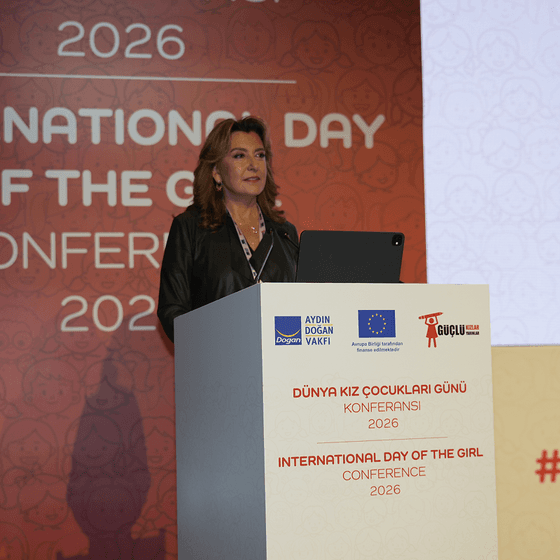
Türkiye’de kız çocuklarının eğitime erişiminde son 20 yılda önemli ilerleme sağlandı; ancak eğitimde kapanan makas, okuldan işe geçişte, ekonomik katılımda ve karar alma süreçlerinde yeniden açılıyor. Bugünün meselesi artık kız çocuklarını yalnızca okula ulaştırmak değil, değişen dünyada kendi yollarını çizebilecekleri beceri, özgüven ve fırsatlarla desteklemek. Aydın Doğan Vakfı, "Güçlü Kızlar Güçlü Yarınlar" projesiyle eşitsizliğin eğitim sonrasındaki halkalarına odaklanıyor.
Bir çırpıda geçen haftanın öne çıkan gelişmeleri.