




People are returning to politics: What does Zohran Mamdani's victory in the US tell us?


 Aposto World
This newsletter offers a comprehensive overview of global events from each continent, curated from diverse international media sources. On Mondays, you will receive Aposto World in your inbox and we will give you only the relevant information on just the important stuff, from an Istanbul perspective.
Politics, as we know it from the 20th century, has long left behind its promising, transformative, collective imagination and utopian horizon. This understanding of politics, in which discourse and gestures took precedence over promises, functioned as a kind of social-engineering activity that was considered a public relations activity, measured by the moves of technocrats, and built on the behavioral patterns of masses that were completely open to drift.
While the elections were reduced to a management play dominated by the stereotypes of political scientists' stereotypes about society, everyone was looking at the theatrical performances of the campaign on the election stage; discourses were melted in the "crucible of politics" by distancing themselves from reality, and a framework emerged that everyone was aware of but "pretended" to be aware of. Indeed, in the last US elections, the campaign of the Democratic candidate Kamala Harris, which ended in a major defeat, did not abandon the language of the status quo, and in fact took on a tone increasingly similar to that of the other candidate, who was characterized as "extreme right-wing" and "enemy of democracy."
On the other side, Trump stood out as an anti-thesis for the masses who were fed up with the deadlock of liberal democracy represented by the so-called "political elite" with his ability to speak unspeakable truths directly, adopting a "transparent" tone against the diplomatic style that the public no longer trusted, and conducting a politics outside the current understanding of governance.
As Bernie Sanders, a prominent Democratic figure, said after Harris' big defeat, the party had lost first the white working class, then the Latino and black working class by continuing the discourse of the establishment and the status quo. With its full support for Israel's genocidal war and a political agenda that completely excluded the classes, the Democratic Party was defeated and handed power to Trump, whom it called "the main enemy of democracy."
Recently, however, a new name has come to the fore in what is seen as a break in the US political climate: Zohran Mamdani, a 33-year-old Muslim and democratic socialist. After winning the Democratic Party's New York mayoral primary against former governor Andrew Cuomo by 43% to 36%, Mamdani became the Democratic Party's candidate for mayor of New York City in the November 4 election.
To understand this rupture, we must first take a closer look at Mamdani's personal story. Born in Uganda in 1991 to Mahmood Mamdani, a Columbia University professor known for his work on colonialism, and renowned film director Mira Nair, Zohran Mamdani immigrated to the United States with his family when he was seven. She studied African Studies at Bowdoin College, where she took her first step into politics and founded the organization Students for Justice in Palestine.

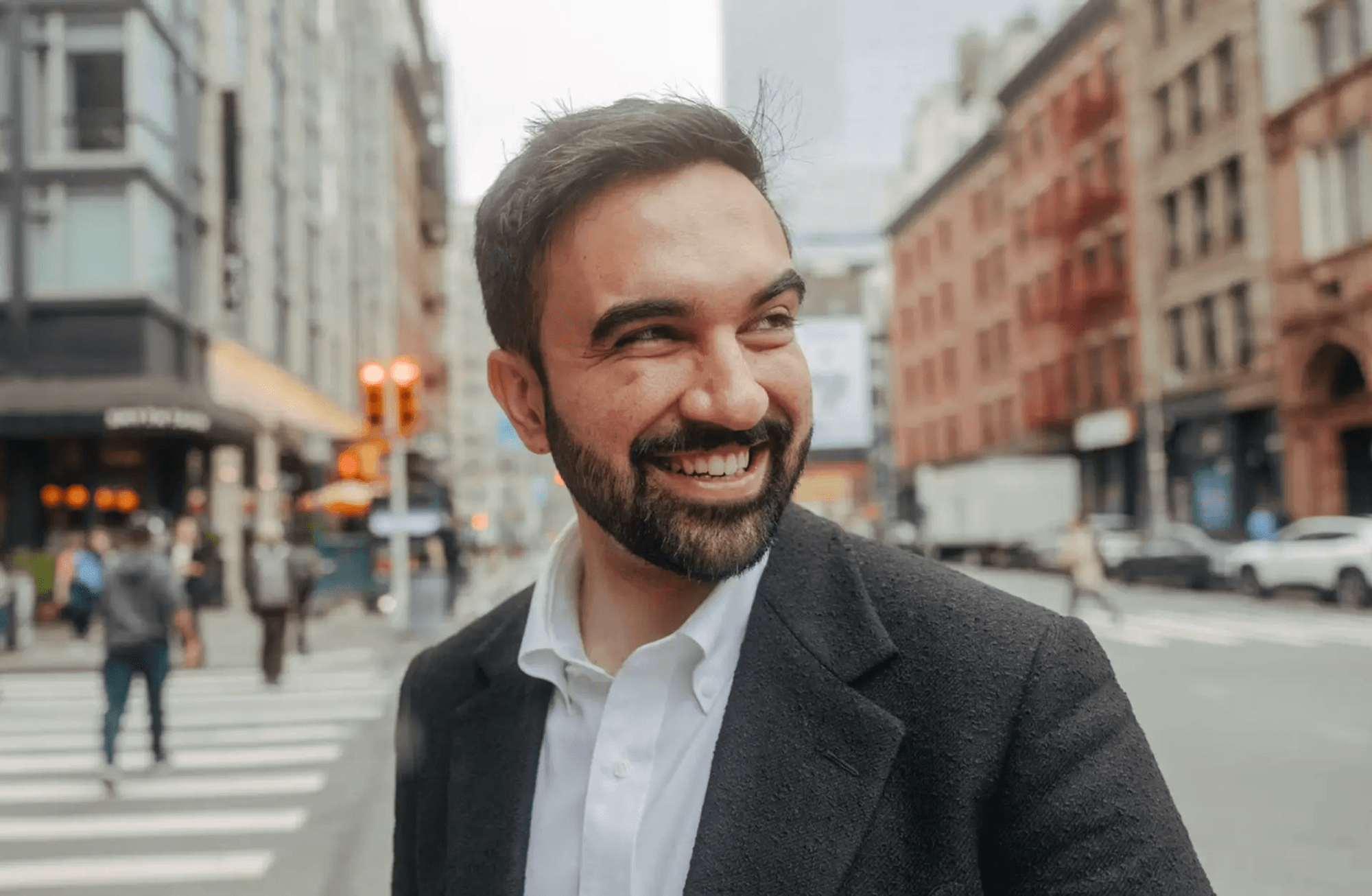
Zohran Mamdani and her husband Rama Duwaji.
After college, he worked as a foreclosure prevention counselor in New York City, helping indebted tenants avoid eviction. Along with politics, Mamdani also began a career in music, making rap music under the pseudonym Young Cardamom and later Mr. Cardamom. In 2017, his song "Salaam" about being a Muslim in New York was frequently discussed by his opponents, especially during the last election process. Mamdani, who became more involved in local politics by working on the campaigns of Democratic candidates in New York, was elected to the New York Assembly in 2020. His candidacy for mayor marked the beginning of a new era in US politics.
Following the Democratic Party’s major defeat in the presidential elections, Mamdani set his sights on the powerful and high-budget office of New York City mayor, positioning himself against Andrew Cuomo, the scandal-plagued representative of the party’s establishment. Mamdani, on the other hand, ran his campaign on a budget of 8 million dollars, much less than his opponent, with record donations from the public. When donations reached $8 million, Mamdani posted a video on social media asking people not to send him any more money.
Author Hamilton Nolan says Mamdani stood out throughout the campaign for his determination to treat voters like adults. By taking time out from the accusations against him, insisting on a public policy, and offering radical solutions to realistic problems, he spoke above the noise to a public that had long felt excluded from the political scene and was fed up with the lack of solutions in liberal democracy. His victory is therefore being hailed as "the end of the old Democratic Party."
Another prominent aspect of Mamdani's campaign was that, unlike his opponent, he pursued an optimistic policy. Cuomo, on the other hand, resorted to the "negative campaigning" method familiar from Turkey, which resulted in a major defeat; he adopted a negative discourse without offering a new vision on problems such as increasing homelessness and crime. Mamdani, on the other hand, made concrete, publicist promises such as free public buses, universal childcare, free daycare centers, a rent freeze on subsidized housing, and municipally-run grocery stores that would be taxed from the rich. Mamdani has created a unique aesthetic using a dynamic form of communication on social media. Mamdani, who often emphasizes that the working class, small businesses and other residents who make New York New York live with great hardship in the city, has gained immense popularity in a short time by addressing concrete problems. By creating an organic ambiance in his videos by focusing on the collective concerns of the city and its inhabitants, Mamdani has created a profile that is well outside the conventional political jargon with an authentic campaign.
Mamdani's approach to the Palestinian issue also played a decisive role in his candidacy. Since October 6, Israel's genocidal war in Palestine has been causing massive social movements in the US. The wave rising in US universities spilled over into the streets and grew larger and larger despite the harsh response of university administrations and the police. While both of his opponents said that they would visit Israel if they won the election and that they were fully behind Netanyahu, Mamdani did not back down, saying that he would arrest Netanyahu if he came to New York.
In the dark climate of liberal democracy ended by technocrats and the deepening and increasingly unsustainable nature of the neoliberal program, there are, of course, there are, of course, those who not take kindly Mamdani's rise. In a statement, Trump said the following about Mamdani:
"He's a communist lunatic, He looks TERRIBLE, his voice is grating, he’s not very smart, Dummies ALL, backing him"
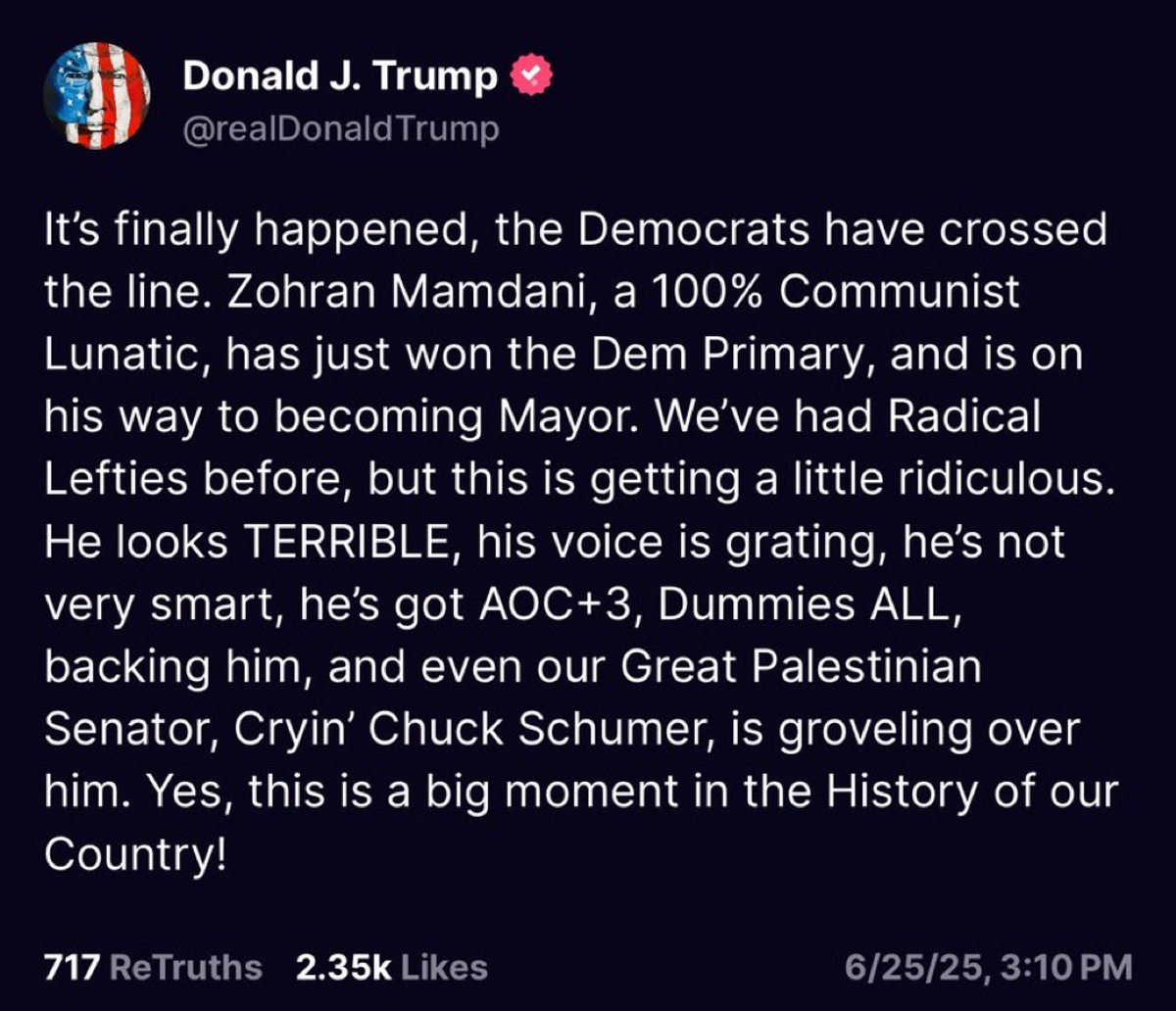
In other words, Mamdani will be running in the November 4 elections not only against the current mayor, Eric Adams, whose name is associated with massive corruption, but also against a coalition of billionaires that includes Trump. Indeed, hedge fund billionaire Bill Ackman said after the results came in that he and his wealthy associates were prepared to pour "hundreds of millions of dollars" into any candidate who defeated Mamdani.
Whatever the outcome of November's elections, Mamdani's victory in the nomination shows that a crack has opened in the understanding of politics that has become alienated from the people, reduced to a professional basis, and turned into a rational mechanism of administration instead of promises.
With the harsh reality of a global crisis, we are witnessing a story in which the real concerns of the people and the public good are invited to the stage, instead of a politics that is increasingly becoming the playground of oligarchs. Moreover, Mamdani has achieved this not with disaster scenarios, conspiracy theories and a politics stuck in the present, but with a political horizon that embodies hope and a common future.
As he himself said after his victory:
If this campaign has demonstrated anything to the world, it is that our dreams can become reality. Dreaming demands hope. And when I think of hope, I think of the unprecedented coalition of New Yorkers that we have built. For this is not my victory. This is ours.


Kaydet

Okuma listesine ekle
Paylaş
Aposto WorldThis newsletter offers a comprehensive overview of global events from each continent, curated from diverse international media sources. On Mondays, you will receive Aposto World in your inbox and we will give you only the relevant information on just the important stuff, from an Istanbul perspective.
İLGİLİ BAŞLIKLAR
YAZARLAR

Enes Köse
Aposto'da sorumlu editör.

Aposto World
This newsletter offers a comprehensive overview of global events from each continent, curated from diverse international media sources. On Mondays, you will receive Aposto World in your inbox and we will give you only the relevant information on just the important stuff, from an Istanbul perspective.
İLGİLİ OKUMALAR

Anna Wintour has stepped down from her role as Editor-in-Chief of Vogue America, a position she has held for 37 years. But is this a farewell or merely a change of scene? When the person in question is a media figure who has shaped the industry around her with an iron will and her enigmatic persona behind black sunglasses, the developments naturally become all the more interesting.

This week, fires broke out in more than 300 locations across Turkey. The longest-lasting fires occurred in forested areas.
04 Tem 2025

Brad Pitt stars in F1: The Movie, which—despite its overwhelming product placement—delivers a whirlwind of excitement that fulfills all the promises of the entertainment industry and mainstream cinema.

Édouard Louis writes with ruthless clarity about his journey from a poor village in northern France to the Parisian intelligentsia, and the interest in his interview at the Moda Stage shows that he is no longer just a writer, but a phenomenon. For many, a Nobel Prize is just a matter of time. He seeks to use his pen to expose violence in a way that no one can escape. We sat down with Louis for a conversation that ranged from the price of classism to shame and the imagination of a new left.

Following the arrest of opposition presidential candidate Ekrem İmamoğlu, Turkey is undergoing weeks of political protests that are shaking up the country's political landscape.
